The television flickers to life. Scenes unfold before you, complete with lonely castles, stalwart heroes, buxom women, and, of course, luridly red blood splattered across a stone tomb — in Technicolor! This is the stuff on which thousands of late-night horror viewings have been built. And tonight’s movie is the ultimate classic of the genre. On to the sophomore entry in our Terrible Vampire Movies column — Terence Fisher’s Horror of Dracula!
Now, to be perfectly fair, I do not consider Horror of Dracula to be a terrible movie. In fact, if it counts as a terrible vampire movie, I am going to say that there has never been a good vampire movie.1 But, it still gets a place in this column for its borderline camp, and for being the origin point of the majority of the imagery that we associate with those films. It is a mock-Gothic marvel, and, if you haven’t seen it yet, you are in for a real treat.
We can’t talk about Horror of Dracula without first talking about “Hammer Horror” — it is, of course, one of the two originating movies for genre.
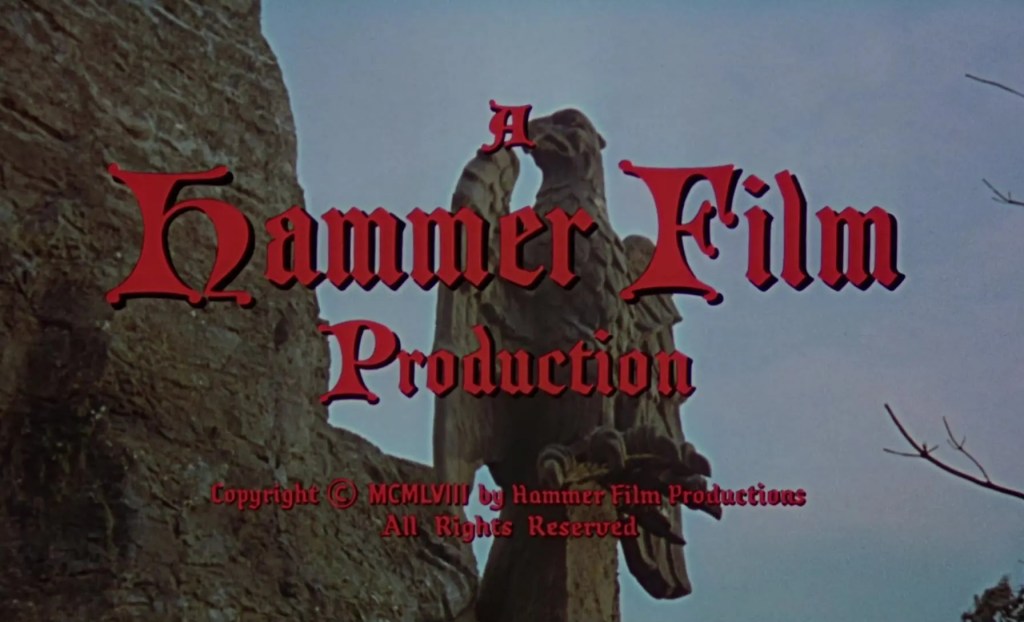
Hammer Films (which started life in 1935 as the distribution company Exclusive Films, before a post-war rebrand in 1947) were originally known for a very different stripe of entertainment. In their early days, they largely adapted already popular plays and radio dramas for the big screen. These were usually mysteries and thrillers, which were recognized staples for British audiences. Then, in the mid-fifties, they began branching out into science fiction, and made a stir with 1955’s Quatermass Xperiment (adapted from Nigel Kneale’s renowned television production The Quatermass Experiment, wherein astronauts accidently bring a deadly alien back to earth) and 1956’s X the Unknown (in which a radioactive mud monster attacks a Scottish village)2. Both films teetered in that ‘fifties Cold War sweet spot between sci-fi and horror. But Hammer Films would not fully commit to the horror genre until 1957, with their release of The Curse of Frankenstein.
Hammer’s Frankenstein is a creepy, sad, and upsetting movie — as it should be — that hits a few of the major plot points of Mary Shelley’s novel, but largely does its own thing. It follows Viktor Frankenstein (played by the wonderful Peter Cushing) through his education, burgeoning obsession with reanimation, and his descent into madness and murder. When the monster (played by Christopher Lee in effective, rotten-looking makeup) murders Viktor’s fiancée and then falls into a vat of acid, Viktor is held responsible for the death (as well as the crimes he had actually committed) and sentenced to death. The movie ends with him on his way to the gallows. It’s a grim, exceedingly aesthetic movie, and audiences loved it. The positive response inspired Hammer Films to enter into negotiations with Universal Pictures to gain the rights to film Dracula, and thus an era was born!
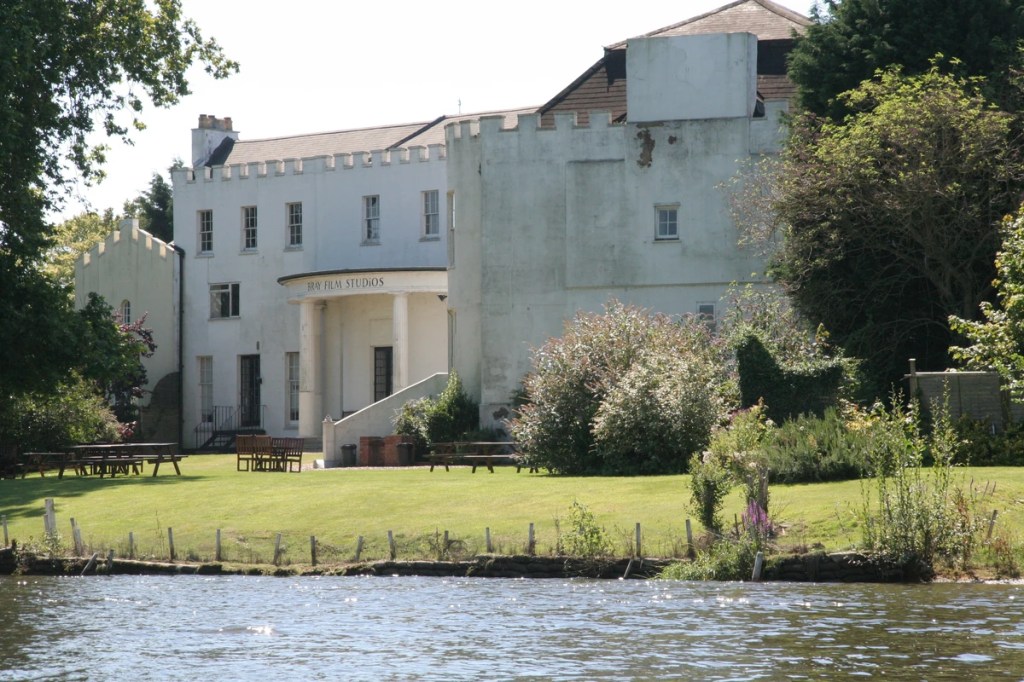
By this point in time, Hammer films had moved location into Bray Studios in Berkshire, which was wonderfully Gothic in its own right, and they would continue to bring that feeling to bear for the next nineteen years of filmmaking. In fact, the grounds themselves would be used fairly regularly as scenery in their films.
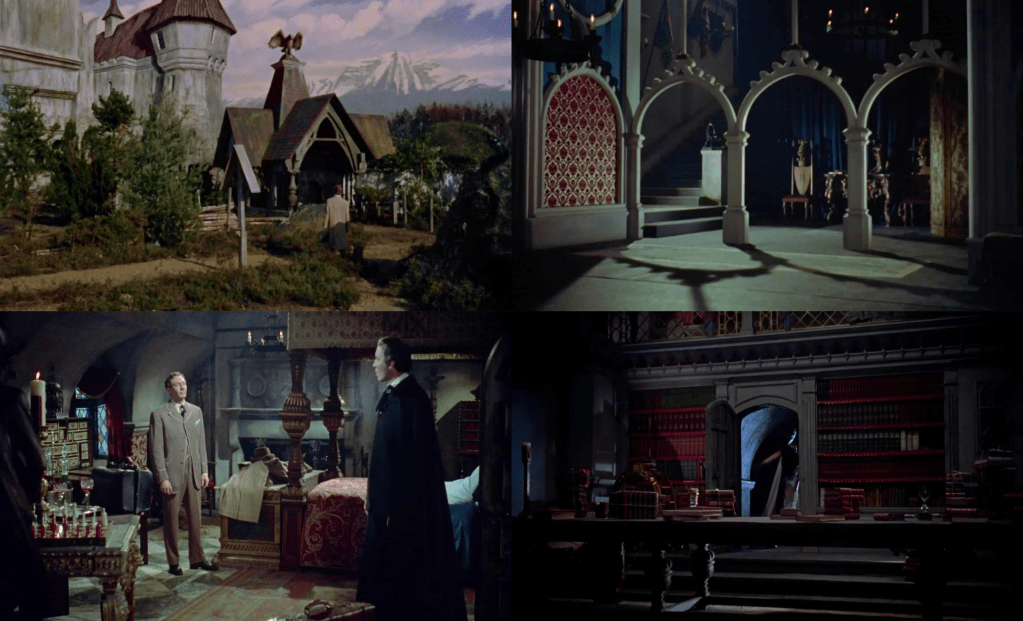
Victoria Grace Walden, in her book Studying Hammer Horror wrote: “Audiences have specific expectations of a Hammer horror film — blood, sexual references, the architecture of Bray studios and surrounding woodlands, James Bernard’s music, and particular stars including Christopher Lee, Peter Cushing, and Ingrid Pitt.” And the amazing thing is that they basically sprang forth fully formed. The only aspect missing from these first two movies is the sublime Ingrid Pitt.3 I would also add that a lot of the Hammer films have a curiously Bavarian vibe. The settings of Horror of Dracula, for example, are the Castle, the small village of Klausenburg, and the city of Ingstadt. Particularly in the village, the settings and the costuming heavily evoke a fairy-tale German-ness that adds to the Gothic feel.
The plot of Horror of Dracula is so wildly divorced from Bram Stoker’s novel as to be laughable. This in no way detracts from how much fun it is, but we should take a few minutes to recap the film. It begins when Jonathan Harker comes to the remote Castle Dracula, to take a position as a librarian in charge of the count’s collection. He is, of course, actually there as a vampire — ready to rid the world of Dracula’s evil once and for all. That being said, he is deeply inept. One of the first things he does on arrival is drop everything off the dinner table. He writes down his true purpose in his diary as soon as he is in his room. He gets bitten by the lady vampire literally his first full day at the castle. But, we’re getting a little ahead of ourselves.
So, where were we? Jonathan arrives at the castle, briefly meets a woman in a skimpy dress who implores him to rescue her from Dracula, and is welcomed by the count himself.4 They briefly discuss his fiancée, Lucy (I told you — they’re playing fast and loose with the source material), and then Dracula locks Jonathan into his room. When the door is unlocked, our hero wanders downstairs, and is almost immediately accosted by the woman from the day before who — surprise! — is a vampire. She bites Jonathan before being dragged away by Dracula.
I do love the way they portray Dracula in active vampire mode. A lot of it banks on the sheer physical presence of Christopher Lee, whose height, poise, and air of coiled athletic energy makes him very compelling. But they also make great use of that black cape (the classic silhouette of Dracula in varying doorways is Christopher Lee), and they use contacts to make the whites of his eyes a lurid, bloodshot red.
Jonathan, having now been bitten, and aware that he is going to become a vampire himself, decides to use his last chance before the sun goes down to defeat Dracula and his minion. Unfortunately, he has not become competent in the interim. Creeping down to the crypt way too close to sunset, he makes the mistake of staking the lady vampire first. Which gives Dracula time to get up, and corner him. Lights out on Jonathan Harker.
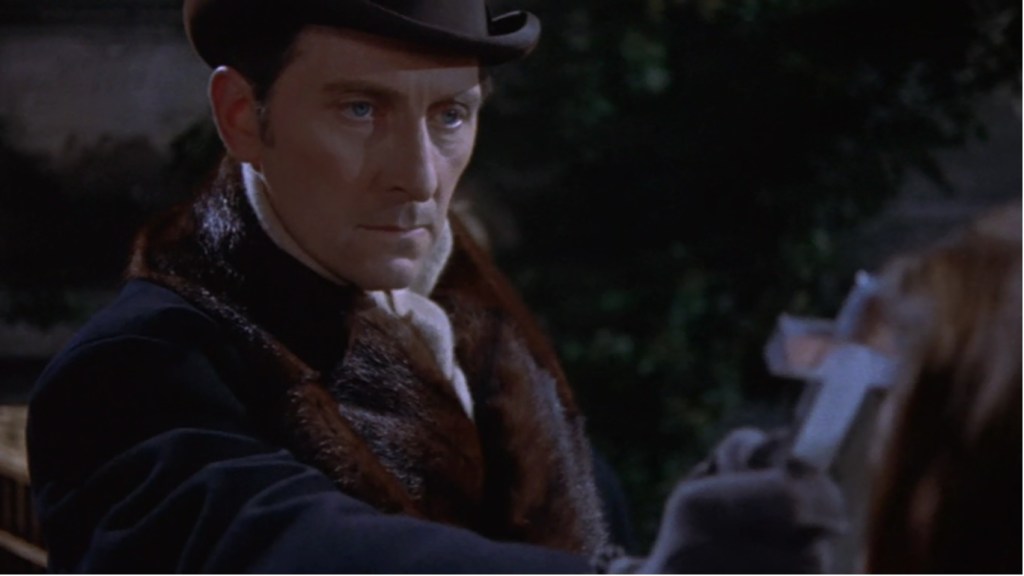
Enter Peter Cushing, as Doctor Van Helsing! Peter Cushing is always one of the best aspects of these movies. He brings a kindly gravitas to his role as Van Helsing that erases any sense of it being absurd. Even in this early film, when he was only in his mid-forties, he has the air of being an indulgent grandfather — albeit one you don’t want to cross. He arrives at a tavern in the village of Klausenburg (once again upholding our curiously German-tinged setting: in the real world Klausenburg is the German name for the Romanian city Cluj-Napoca, and Klausenberg is a mountain in the Bavarian Alps), searching for Jonathan. The frightened townspeople encourage him to simply leave, rather than incur the wrath of the vampire.
Of course, it would be a very short movie if he did that. So, Van Helsing ventures to the castle — too late to stop the count’s departure. He finds a now vampiric Jonathan in the crypt, and does what needs to be done. (Sorry, Jonathan. You were even more hapless than the original.)
Van Helsing returns to the city of Ingstadt (this is, perhaps, just a weird pronunciation of “Ingolstadt,” a city in Bavaria that is also one of the settings for Mary Shelley’s Frankenstein) to break the news of Jonathan’s death to Lucy and her family. Her older brother, Arthur Holmwood, and his wife, Mina, meet with him, but keep the sad news from Lucy as she is “not well enough” to be told. She is suffering from what appears to be pernicious anemia, but we all know what’s actually going on.
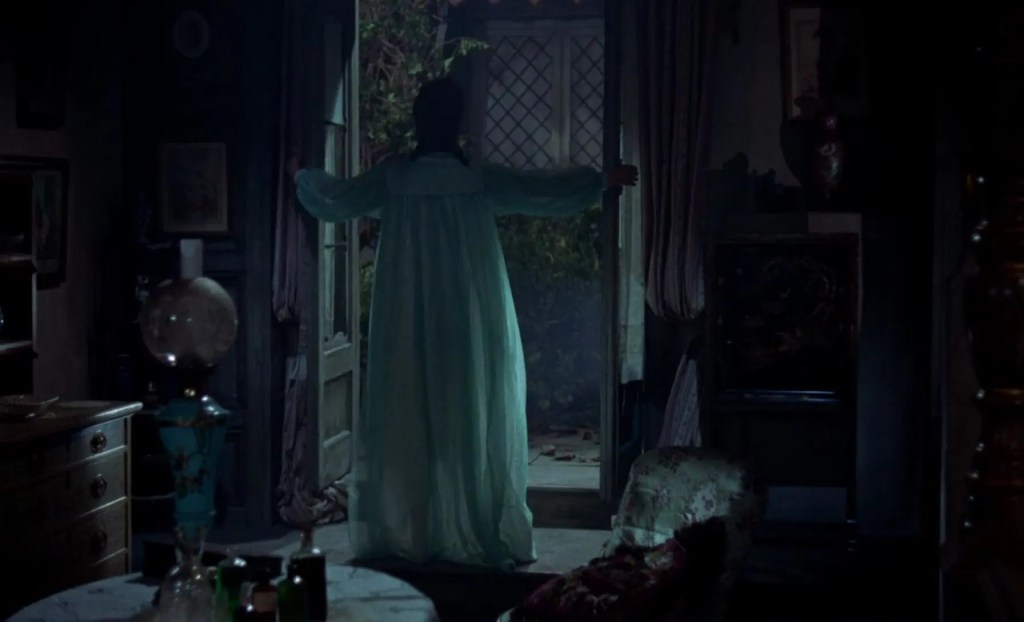
Another classic scene shows up here — Lucy, in the prerequisite diaphanous nightgown that shows she is in the vampire’s thrall, opens the French doors to await Dracula’s arrival. He appears, silhouetted starkly in the window, and descends to where she is artfully draped across her bed.
Come the morning, Lucy is weaker than before, and Mina goes to Van Helsing for a second opinion on her sister-in-law’s condition. He gives the classic advice: close all the windows, fill the room with garlic flowers, and leave it that way all night. That night, preparations made, we see a distinct change in Lucy — she is frantic and uncomfortable, and insists that the maid, Gerda, remove the flowers and open the window. Which she does. (Gerda, you had one job.)
Lucy, of course, dies and returns as a vampire. Actually, this is one of the honestly spooky parts. Again, the atmosphere does a lot of heavy lifting. Gerda’s daughter Tania5 is lured out into the woods around Lucy’s crypt, and is rescued in the nick of time by Van Helsing and Arthur. On seeing his beloved sister as a vampire, Arthur has a bit of an existential crisis, but also leaves staking her to Van Helsing.
They head back to the Holmwood’s house to discuss their next moves in attempting to locate Dracula. While they try to track his course to Ingstadt, Dracula lures Mina to his current hiding place, and feeds on her. They do eventually suss out that Dracula is after a new victim — and is literally in the basement of the Holmwood’s house — just in time for him to grab Mina and hurriedly escape back towards Castle Dracula. A thrilling chase ensues, ending in the showdown between Van Helsing and the vampire. Using two candlesticks to make a cross, Van Helsing backs Dracula into a corner and traps him with sunlight — which dramatically turns him to dust. A win for our heroes!
It’s a deeply satisfying hour and a half. But whence comes the enduring allure of this movie? How has its framework and visual style become the perpetual imagery of vampire tales, even 60-plus years later? Well, quite frankly, because it’s a great movie.
As John L. Flynn wrote in his book 50 Years of Hammer Horror:
“Although the film is far from perfect, it is an ambitious, visually attractive production. Fisher’s uncanny sense of atmosphere, use of pace and color, and ability to build suspense from divergent points of view had gone back to the roots and rituals of the traditional fairy tale in which good triumphed over evil. He had given the vampire story credibility again. With the added dimensions of Technicolor, his film is a real pleasure to watch, even today.”
Yes, exactly!
As you can clearly see from the screenshots above, this is not a low-budget production. It may not look like a modern movie, true, but it was clearly crafted with a coherent vision, and it delivers. All of the actors are invested. The music is wonderfully creepy. The theatrical, Gothic-inflected feeling has the edge of danger and the illicit, without ever veering into territory that is too dark. Even the omnipresent blood is too red to be anything but lurid and over the top — it is very clearly paint, not blood, just there for the thrill. It is just pure fun, from start to finish.
And, Horror of Dracula was a departure from the Universal pictures. By this point in time, Universal had exhausted any actual tension to be gotten from their monster movies, and relegated them to punch lines in Abbott and Costello films. Hammer gave them the Gothic reboot they so richly deserved. Lush color, rich scenery, and a new cast injected life and energy into something that had gone stale. And, as I have pointed out, the charisma of Christopher Lee and Peter Cushing brings a lot to the screen. They would, between the two of them, make a total of eight Dracula films at Hammer, not to mention a number of other collaborations with a variety of studios.
As a fun aside, Christopher Lee and Peter Cushing were exceedingly good friends even off-screen6. One of my favorite anecdotes about them involves their love of Looney Toons cartoons. Apparently, they would go watch cartoon shorts in the theatre, and found them so raucously amusing that they were once actually asked to leave. Not exactly the scariest pastime. Honestly, there’s something pleasing about imagining how much fun it must be to get paid to play spooky make-believe with one of your best friends. I hope they had a blast every time they made a movie.
I don’t really have any great wisdom to impart about this one — I just love talking about it. Honestly, Horror of Dracula is one of my very favorite movies, horror and otherwise. It’s earnest, atmospheric, and a good time. So, go ahead: make yourself a cup of tea, settle on the couch with a blanket, and spend your evening enjoying a true classic. You might just want to have a cross and some garlic near to hand.
- Despite my love of the genre, this may actually be true. ↩︎
- In case you’re wondering why both titles use the letter “X” so prominently (you were wondering, right?) — it was to highlight that the films were both given an “X certificate” by the British Board of Film Censors. These are naughty films, folks. Well, naughty-ish. (The “X certificate” rating today would be “18” in the UK or “R” in the US.) ↩︎
- Ingrid Pitt usually played a vampire in her own right, and is not generally a part of the Hammer Dracula canon. She does show up alongside Christopher Lee in movies like The Wicker Man and The House That Dripped Blood (her segment of the latter is, amusingly, something of a parody of Hammer films) ↩︎
- “I am Dracula, and I welcome you to my home.” Intriguingly, this part of the movie is the only place where Dracula speaks. He has a conversation with Jonathan that comprises perhaps thirteen lines. Once we’ve seen him as a vampire, he does not utter another word for the rest of the film. Christopher Lee still has so much on screen presence that the majority of people don’t even notice this. ↩︎
- An enduring frustration: it would make much more sense if Tania was Arthur and Mina’s daughter. She refers to Lucy as “Aunt Lucy,” has free roam of the house, is very well-dressed, and just doesn’t make much sense as the maid’s daughter. I actually usually forget that she is meant to be Gerda’s daughter. ↩︎
- The horror dynamic duo made 24 films together. Several of them will make appearances in this column. ↩︎


This was so much fun! Thank you for sharing! 😀 I just looked it up, and it looks like our library system has a copy, gonna to have to request that for watching during this spooky season!
LikeLike
I can’ wait to hear what you think of it!!
LikeLike