Ghost Stories for Christmas

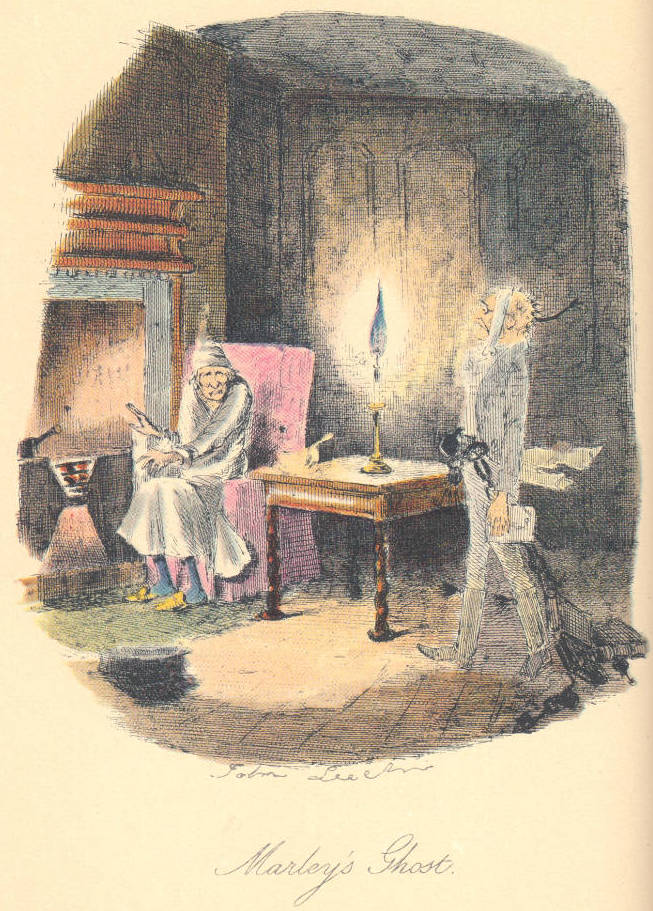
John Leech's original illustration of Ebenezer Scrooge being visited by the ghost of Jacob Marley in A Christmas Carol

Marley was dead to begin with. There can be no doubt whatsoever about that.

And with those immortal words, generations have settled in to embrace the spirit of Christmas — with ghosts. I know very few people1 for whom A Christmas Carol is not an integral part of their idea of the holiday itself. Whether their introduction to it was the text itself, the Muppet version (which actually does include a surprising amount of Dickens’ own words), or any of the myriad other forms and adaptations, its depictions of family and friends getting together in joy, its message of compassion and good will to all mankind, even its nineteenth century trappings of geese and pudding and silly games have all become the markers of the season and the holiday. Yet, for all its good cheer, it is emphatically a ghost story — and a creepy one at that!

Think of the scene when Scrooge, alone in his darkened rooms, hears the sound of Marley’s ghost coming for him:

After several turns, he sat down again. As he threw his head back in the chair, his glance happened to rest upon a bell, a disused bell, that hung in the room, and communicated for some purpose now forgotten with a chamber in the highest story of the building. It was with great astonishment, and with a strange, inexplicable dread, that as he looked, he saw this bell begin to swing. It swung so softly in the outset that it scarcely made a sound; but soon it rang out loudly, and so did every bell in the house.

This might have lasted half a minute, or a minute, but it seemed an hour. The bells ceased as they had begun, together. They were succeeded by a clanking noise, deep down below; as if some person were dragging a heavy chain over the casks in the wine-merchant’s cellar. Scrooge then remembered to have heard that ghosts in haunted houses were described as dragging chains.

The cellar-door flew open with a booming sound, and then he heard the noise much louder, on the floors below; then coming up the stairs; then coming straight towards his door.
Continue reading

We Turn Towards Hope

This is a slight change from our usual posts, and I hope you will bear with me as I muddle my way through. I have been thinking a lot this week about the link between hope and horror. I am not going to lie and claim that it was an intentional and organized framework for an article — like many of us in the United States I have mostly been trying to keep my head above water and make sense of where we are right now. In fact, I had forgotten about this website entirely until I was already in bed last night. But here we are.

And I am very glad that you are here.

Continue reading

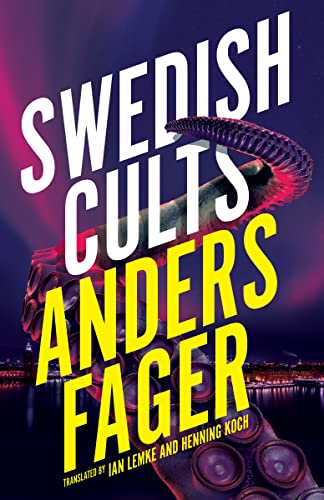
“How Deep the Abyss Really Is”: A Quick Review of Anders Fager’s “Swedish Cults”

Anders Fager’s creeping, ichor-sticky collection, Swedish Cults, begins with a story about, well… a cult. But it’s the kind of cult action I absolutely love, in which there is no great fanfare about all this ritual business, and the cult itself sits almost comfortably in plain sight, a set of practices and traditions that everyone in a community more or less acknowledges as having always been there. “The Furies of Boras” sees a modern set of teenage girls out at a dancehall, at a place where there has always been dancing, and as perennial as teenage girl politics and concerns, as perennial as the dancing, is the thing in the bog waiting for its due.

“Anna closes her eyes, sees primeval swamps behind her eyelids. Swamps and rain and kisses. The Pussycat Dolls’ ‘Don’t Cha’ blares through the speakers. Sofie scans the place. She’s thinking about her history project. There’s a lot going on in your head your final year. Industrialism in the Vastergotland region and bogs and kisses. … Stares at the girls and stares at a telephone pole of a tentacle less than a meter from her forehead. A twitch and she’s dead. Not much fun. And on top of everything she has an essay to hand in.”

All of Fager’s stories have this matter-of-factness, a sense of brains skipping a beat when forced up against the incomprehensible, sliding over hysteria and protest directly into a kind of shock of acceptance. There is something indelibly human about a high schooler in a cannibalistic orgy, watching the lumbering, eldritch swamp-beast she and her cohorts are petitioning, worrying about a history essay she has to write. Such a detail might seem farcical in the hands of a less-keen observer, but Fager knows how to fit the mundane against the outlandish pretty seamlessly.1 His Lovecraftian horrors are glimpsed rather than belabored, appearing obliquely in conversations between two old friends, in the subtle changes in a boyfriend returning from abroad, in a name uttered into the winter air. In his precisely-drawn characters, appearing as sharp as miniatures in the brief space they occupy, we feel lives proceeding mostly normally until, inexorably, they slip into the uncanny; as with Laird Barron’s horror fiction, much of the impact of Fager’s work lies in this dread as things slip away from the familiar with no hope of getting back to the right path.

Valancourt Press, which published this for American audiences, has been doing a lot for weird fiction both vintage and contemporary; their republishing of many of the luridly great titles featured in Grady Hendrix’s delightful Paperbacks from Hell is a tremendous service to an all-too-ephemeral age of horror fiction. I’m really looking forward to checking out many more of their offerings based on the strength of this title alone. 

  1. Definitely to be credited here, too, are his very capable translators, Ian Lemke and Henning Koch. ↩︎

Recording Begins — a recommendation for “The Magnus Archives”

This has been a hectic week, but there has still been time for listening to podcasts! And, I would definitely like to recommend my current favourite to all of you:

The Magnus Archives

The Magnus Archives is a horror series put out by Rusty Quill. The overall conceit is that it comes from the archives of the Magnus Institute, a British organization whose mission is to investigate weird and paranormal occurrences. The most recent archivist (a wonderfully curmudgeonly Jonathan Sims, who also writes the programme) is attempting to impose some order on the chaos left by his predecessor.

The majority of the files are subsequently narrated by Sims himself, whose reading of them is understated in the best possible way. Each is its own short story — with a truly impressive variety of voices and tones — that range from slightly eerie to outright terrifying. Personally, I love the less flashy stories best. The more mundane they seem at the outset, the more they feel very, disturbingly real.

While it is, largely, an anthology series, The Magnus Archives still delivers in effective world-building. As the series progresses, there are names that start popping up repeatedly, and hints that something more is going on. I’m not going to spoil any of it for new listeners. The slow build is definitely part of the fun.

There is always the temptation to compare something new to its predecessors — and there is something SCP-esque about the whole set-up — but it has a flavour and flair very much its own. Fans of the Weird should definitely give The Magnus Archives a listen.

But What Lurks Without? M. R. James vs. H. P. Lovecraft

It’s sort of strange how omnipresent H. P. Lovecraft is in horror conversations, even now. The legacy of his particular branch of weird is substantial — and, largely, a conversation we are saving for later on. Don’t worry, there is still a lot to say.

A less well-known figure holds a much closer place in my heart: M. R. James.

On the surface, it is strange to compare these two men. James was the father of the antiquarian ghost story. Lovecraft basically created the genre of cosmic horror. And yet, there really is a great deal of common ground. They were, in fact, contemporaries, and died within a year of one another (James in 1936, Lovecraft in 1937). Both wrote stories that took their sensibilities from earlier time periods. Both have had impacts on the horror genre that they never would have foreseen. Both were solitary men whose sexuality is a preoccupation of modern scholars. And, most importantly, both based their horror in a fear of the Outside, of the arcane, and of the forbidden.

Perhaps it’s best to start with some brief biographical notes.

Continue reading