Marley was dead to begin with. There can be no doubt whatsoever about that.
And with those immortal words, generations have settled in to embrace the spirit of Christmas — with ghosts. I know very few people1 for whom A Christmas Carol is not an integral part of their idea of the holiday itself. Whether their introduction to it was the text itself, the Muppet version (which actually does include a surprising amount of Dickens’ own words), or any of the myriad other forms and adaptations, its depictions of family and friends getting together in joy, its message of compassion and good will to all mankind, even its nineteenth century trappings of geese and pudding and silly games have all become the markers of the season and the holiday. Yet, for all its good cheer, it is emphatically a ghost story — and a creepy one at that!
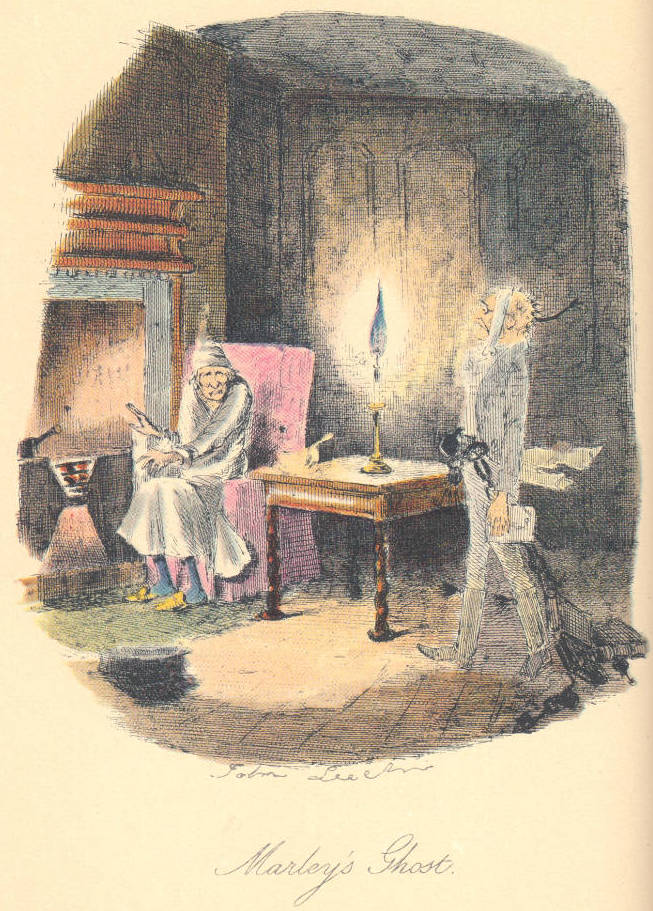
Think of the scene when Scrooge, alone in his darkened rooms, hears the sound of Marley’s ghost coming for him:
After several turns, he sat down again. As he threw his head back in the chair, his glance happened to rest upon a bell, a disused bell, that hung in the room, and communicated for some purpose now forgotten with a chamber in the highest story of the building. It was with great astonishment, and with a strange, inexplicable dread, that as he looked, he saw this bell begin to swing. It swung so softly in the outset that it scarcely made a sound; but soon it rang out loudly, and so did every bell in the house.
This might have lasted half a minute, or a minute, but it seemed an hour. The bells ceased as they had begun, together. They were succeeded by a clanking noise, deep down below; as if some person were dragging a heavy chain over the casks in the wine-merchant’s cellar. Scrooge then remembered to have heard that ghosts in haunted houses were described as dragging chains.
The cellar-door flew open with a booming sound, and then he heard the noise much louder, on the floors below; then coming up the stairs; then coming straight towards his door.
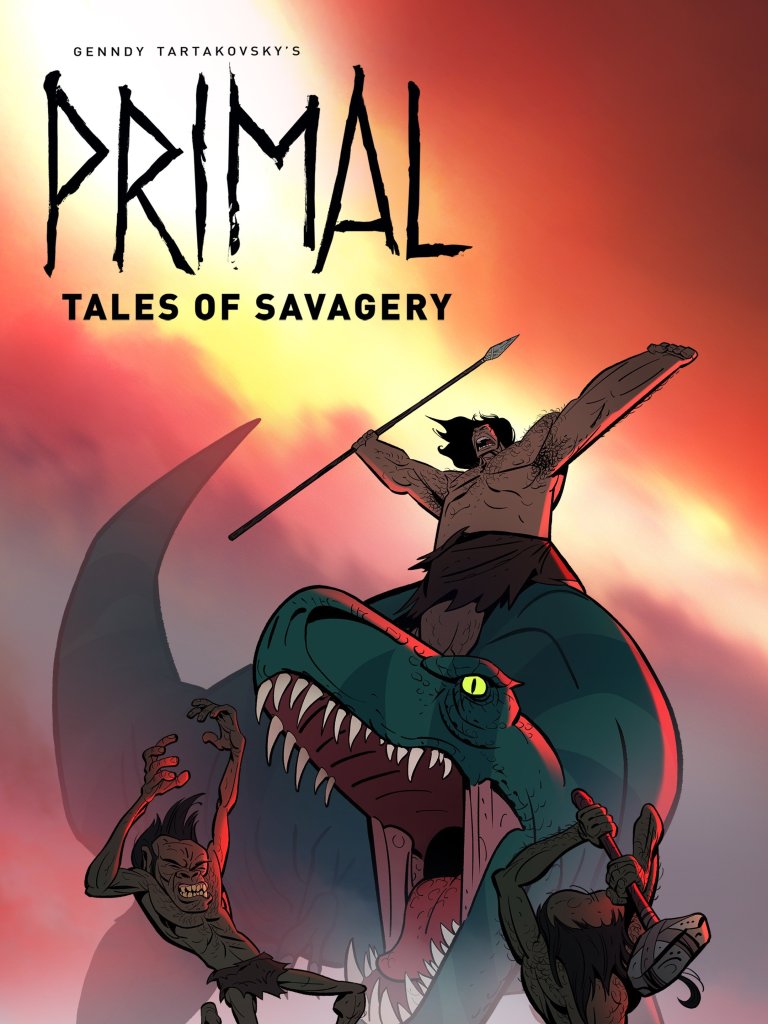
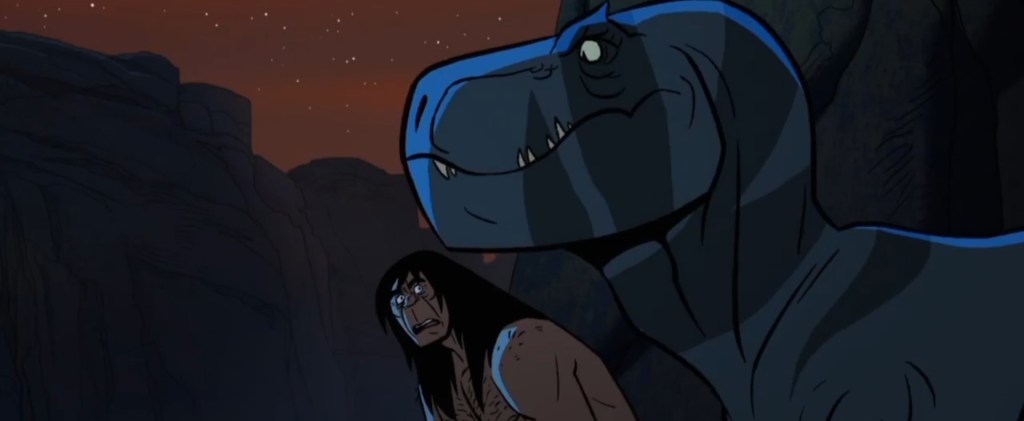
Genndy Tartakovsky’s Primal, his two-season epic animated series featuring the journeys of Spear, a Neanderthal, and Fang, a tyrannosaur, is an incredible achievement in world-building. It’s pulpy, imaginative, emotional, and tense, each episode a remarkably heady and rich tapestry of landscape and character, packing in way more depth than every 22-minute runtime seems able to contain. And the show builds this world with absolutely no words spoken. Tartakovsky’s work thrives on a minimum of dialogue (see Samurai Jack and The Clone Wars at their finest), but Primal eschews it altogether, orienting us toward the world as Spear and Fang see it, as a network of complex interactions between creatures trying to survive an unforgiving existence. Close observation is essential to their success in this world, and so we, too, are keenly attuned to the beings they encounter. We can’t rely on linguistic explanation for what we see, and so are locked into this highly intimate, emotive focus. A lesser filmmaker would stumble at the admittedly very tall order of getting audiences deeply attached to a caveman/t-rex duo, but Tartakovsky knows what he’s about.
This setting, filled as it is with prehistoric creatures and weird magic, allows for a lot of tension and spookiness, but nothing matches the sheer terror of “Plague of Madness,” an episode in the show’s first season. It encapsulates everything Primal does so well. It’s visually arresting, it communicates the inner lives of the protagonists and of the animals they meet so keenly, and it asks us to face a world before and beyond the explanatory crutch of metaphor. It also answers a question close to the hearts of many horror fans: how do you make zombies scary again?
Easy! Make the zombie a thirty-ton brachiosaurus1.
Oh no.
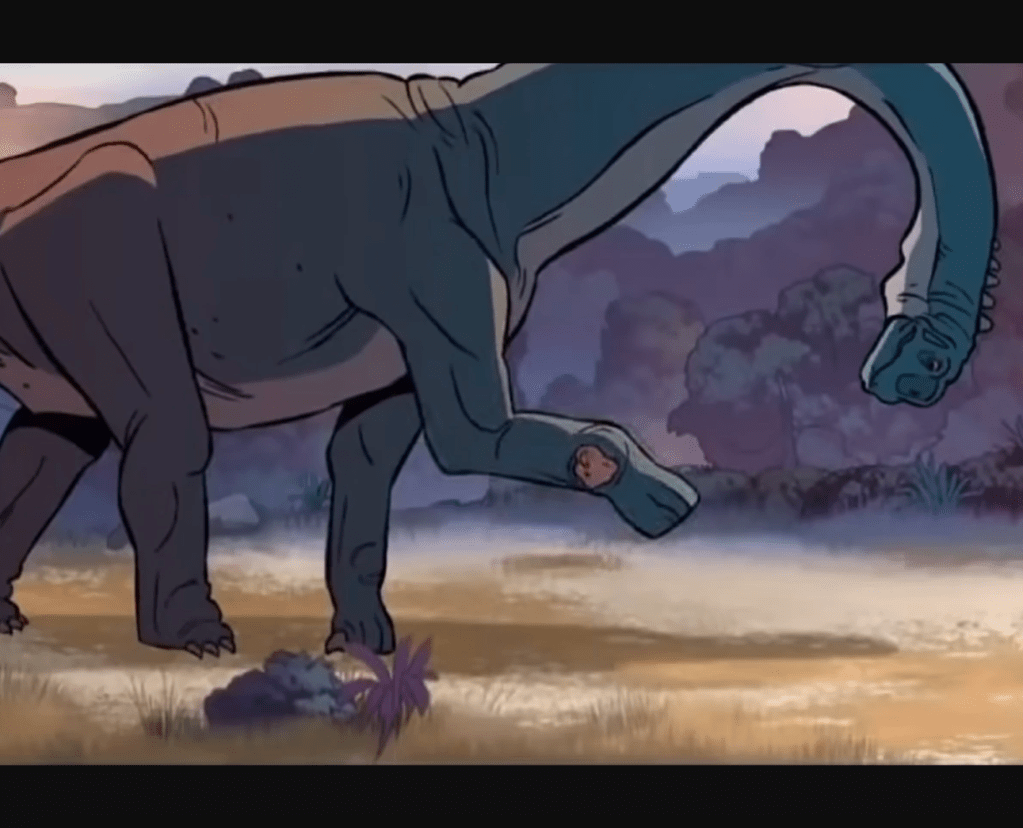
The episode begins with unusual tranquility for the show, with a herd of sauropods peacefully going about their business, grazing leaves, tending their eggs, chilling out in pools. Like all of Tartakovsky’s non-human characters, these creatures are imbued with great inner life, their expressions and body language imparting intelligence, dignity, and gentleness. The bucolic scene is punctuated by an incredibly small, comparatively, intruder- a spastic, mad-eyed, drooling parasaurolophus, staggering with rabid loopiness toward one of the brachiosaurs. A tiny bite from this tiny animal on the giant’s leg is enough to doom this whole scene to an insane hell, but as the brachiosaurus flicks the smaller dinosaur away into a tree, eyeing its death-spasms with cautious worry, it feels impossible that this towering creature could be ruined by this insignificant one. It compounds the sense of dread.
OH NO.
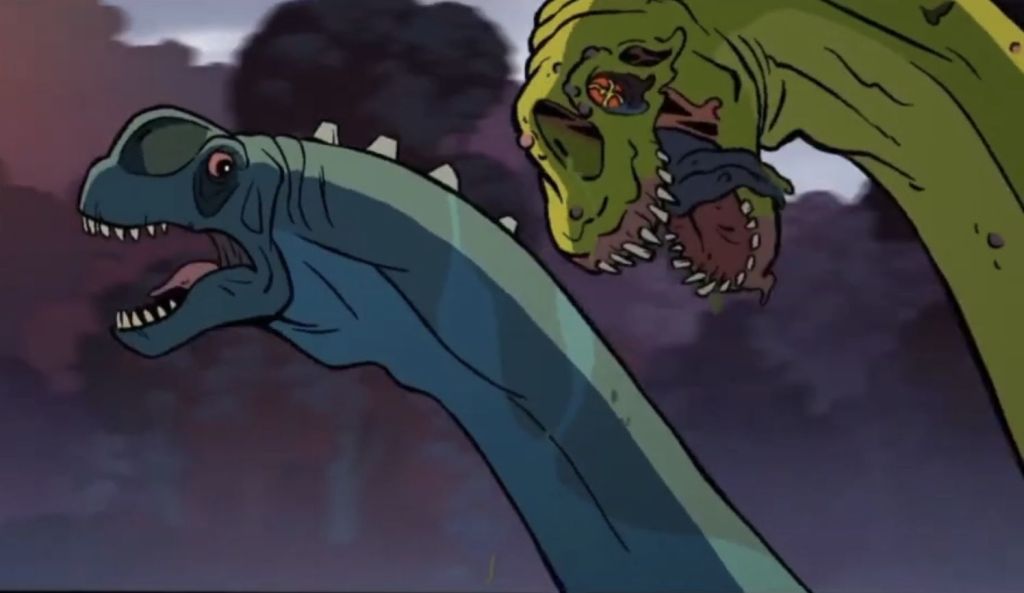
We’re not given much time to dread, however, as the infection takes over the brachiosaurs. We see it struggling toward water, clearly sick, and while we know, in a way, what’s coming, it’s tragically clear the animal doesn’t. It gulps down water in an attempt to alleviate a fever we know is completely unnatural, before violently vomiting blood and succumbing to the full madness of the plague. It’s damn gross, but worse is the now-mindless creature’s rampage against its herd, wherein it breaks backs, tramples eggs, bites and kicks its baffled compatriots into so much pulp. There’s no reason we can see for its sudden, explosive frenzy, but of course there is no reason.
Spear and Fang come across the aftermath of this bloodbath, and even the tyrannosaur is stricken by the carnage. Neither of the protagonists, for all their predatory acumen, would be able to tackle the brachiosaurs, and we see their unease as they wonder what animal is of a size to do so. One of their own, it turns out. Deprived of any other focus for its compulsive violence, the brachiosaurus fixates on the appropriately horrified Spear and Fang, launching an utterly terrifying chase through jungle and down sheer cliffs. The thing just. Won’t. Stop. It’s beyond living, beyond thought, reduced to this juggernaut of intractable hostility and rotting meat. It’s prehistoric Cujo.
My thoughts exactly, guys.
Heightening the tension of the episode is Spear’s understanding of how corrupted and unnatural this creature has become. He is frightened by it in a way we haven’t really seen in the character before, on a seemingly existential level; a nightmare in which he and Fang both succumb to the same affliction as the brachiosaurus, their flesh melting and their minds evaporating, reveals a deeper dread than Spear’s usual concerns about survival. Whatever has afflicted the sauropod is crueler and more utterly annihilating than death. The plague is self-erasing, completely negating what this animal once was, its innately pacific, dignified nature obliterated. At risk is his own inner life, his own keenly felt sense of what he is in the world he inhabits. This plague is worse than death. It’s annihilation.
It’s this intimate focus on individual erasure which makes the brachiosaurus such a satisfyingly scary monster. The deranged brachiosaurus is what we would recognize as a zombie- it’s dead but still ambulatory, it had a soul or an active intelligence which it has lost- but it’s a zombie which stands for nothing else. It serves no commentative purpose because its world matrix has no society to comment on. What’s left is a very distilled, very effective terror, and a very personal one. It also injects pathos back onto the zombie. We understand the mad brachiosaurus as an individual, its condition as upsetting and tragic as it is terrifying. It’s not really fair that this happened to it, and again the spirit of poor Cujo is present. Neither animal did anything to deserve their fates, and we wish they hadn’t suffered them, even as we also really wish they would please, please just die. Spear’s fear of this creature, like ours, is tempered by the same pity. He and Fang lead the beast into a lava field where it blunders into the magma and finally perishes, though not before being fully engulfed into fire and still trying to kill them. As he watches it flail and scream in rage, at last becoming nothing but so much ash, Spear is clearly stricken by the unfathomable, grotesque fate of this creature. There’s no triumph in its defeat, just horrible relief.
A rare instance of the zombie evoking pathos.
I love this show for a lot of reasons, but this one episode is such a stark statement on how horror can function separate from its tendency to be used as metaphor. The brachiosaurus stands for nothing- it is a void, truly Unnatural. By stripping away so many of the trappings of modernity, by focusing on the minute details of character in a rich but rarely human world, Tartakovsky reminds us that fear is far more base than our epistemic habits permit. It’s nothing but itself, hitting at the deep, wordless core of ourselves. Primal.
Technically, it’s an Argentinosaurus. Visually, the two species are very close, and I think brachiosaurs are more recognizable, so that’s the term I’ll be sticking with. It’s not scientific, but neither are zombie dinosaurs. ↩︎

 the shadowes are icumen in