Ghost Stories for Christmas

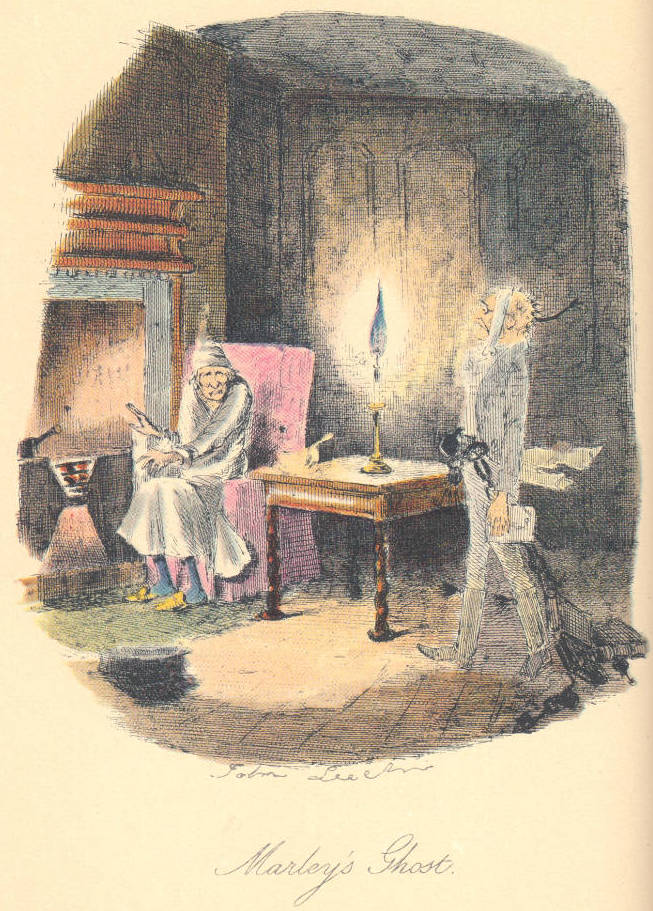
John Leech's original illustration of Ebenezer Scrooge being visited by the ghost of Jacob Marley in A Christmas Carol

Marley was dead to begin with. There can be no doubt whatsoever about that.

And with those immortal words, generations have settled in to embrace the spirit of Christmas — with ghosts. I know very few people1 for whom A Christmas Carol is not an integral part of their idea of the holiday itself. Whether their introduction to it was the text itself, the Muppet version (which actually does include a surprising amount of Dickens’ own words), or any of the myriad other forms and adaptations, its depictions of family and friends getting together in joy, its message of compassion and good will to all mankind, even its nineteenth century trappings of geese and pudding and silly games have all become the markers of the season and the holiday. Yet, for all its good cheer, it is emphatically a ghost story — and a creepy one at that!

Think of the scene when Scrooge, alone in his darkened rooms, hears the sound of Marley’s ghost coming for him:

After several turns, he sat down again. As he threw his head back in the chair, his glance happened to rest upon a bell, a disused bell, that hung in the room, and communicated for some purpose now forgotten with a chamber in the highest story of the building. It was with great astonishment, and with a strange, inexplicable dread, that as he looked, he saw this bell begin to swing. It swung so softly in the outset that it scarcely made a sound; but soon it rang out loudly, and so did every bell in the house.

This might have lasted half a minute, or a minute, but it seemed an hour. The bells ceased as they had begun, together. They were succeeded by a clanking noise, deep down below; as if some person were dragging a heavy chain over the casks in the wine-merchant’s cellar. Scrooge then remembered to have heard that ghosts in haunted houses were described as dragging chains.

The cellar-door flew open with a booming sound, and then he heard the noise much louder, on the floors below; then coming up the stairs; then coming straight towards his door.

Continue reading

Loudly Sing Cuckoo: A Perspective on The Wicker Man (1973)

Dan Mumford’s poster for The Wicker Man

Come. It is time to keep your appointment with the Wicker Man.

Those words, uttered in the stentorian tones of Christopher Lee, echo through the history of horror cinema. And it is, indeed, time that we come to The Wicker Man. It, alongside The Blood on Satan’s Claw and The Witchfinder General, makes up what is often termed “The Unholy Trinity” of folk horror. It is the Ur Text of the genre. The sharp-eyed among you may have noticed that even the name of this website is an homage to the film, and its stunning final scene.

Full disclosure before we begin: I want to like this movie so badly. I can’t say that I actually do. I am, in the truest sense of the word, deeply ambivalent about it. There are moments that I think are perfect. The shape of it appeals to me immensely. The rest of the time it is weirdly groovy, kind of a mess, and feels like it gets in its own way.

None of this has stopped me from watching it multiple times, trying to nail down what about it remains compelling. And, clearly, I am not alone in being intrigued. There is a wealth of writing about The Wicker Man, ranging from densely scholarly essays to enthusiastic rambles to harsh film criticism. But we do all keep coming back to Summerisle.

While the imagery and afterlife of the film are ubiquitous, I’m not sure how many people have actually seen it. So, we are going to take a moment for a brief synopsis.1

Continue reading

We Turn Towards Hope

This is a slight change from our usual posts, and I hope you will bear with me as I muddle my way through. I have been thinking a lot this week about the link between hope and horror. I am not going to lie and claim that it was an intentional and organized framework for an article — like many of us in the United States I have mostly been trying to keep my head above water and make sense of where we are right now. In fact, I had forgotten about this website entirely until I was already in bed last night. But here we are.

And I am very glad that you are here.

Continue reading

A Definitely Positive Review of Hellboy: The Crooked Man (2024)

When it was first announced that another Hellboy movie was in the works, I was tentatively excited. The comics are, of course, a perennial favorite, as is the Guillermo del Toro version.1 The 2019 movie had one truly brilliant scene2 but was largely an oddly-paced, muddled mess. Still, I never turn down Hellboy, and the title was a promising start. The Crooked Man is a wonderfully spooky story, and I liked the idea of a new movie taking on one of the standalone tales rather than diving into the end game. So, I waited to hear more, and… nothing. Having assumed that the movie — like so many titles — was a project that had simply dropped into the ether, never to be seen again, I forgot about it until people started making noise about a trailer. The trailer looked low-budget but creepy (which, as you all may have noticed, is my favorite kind of horror movie). I went back to being excited.

Then, once again, nothing. No updates, no theatrical release, just radio silence about it being available in the United States.

I will admit, by the time I saw it available to purchase online, I was feeling my doubts. As of sitting down to do so, it had a 29% rating on Rotten Tomatoes.3 Combined with the decision to release it direct to streaming, I was braced for it to be bad. Imagine my shock, dear reader, when it was not bad. In fact, I greatly enjoyed it. It’s not perfect — and we’ll get back to that — but it’s creepy, atmospheric, and fun. And, it feels like the comics. Honestly, go watch it with an open mind and you’re going to have a good evening.

For those of you who are less familiar, here is the basic shape:

While in southern Appalachia in the late 1950s, Hellboy comes across a local resident who has been harmed by a witch. Together with a recently-returned local named Tom Ferrell, who has his own history with the witchcraft and evil in the region, he sets out to look into the matter. Together, they go to bury Tom’s father and confront the local manifestation of the devil — the so-called “Crooked Man”. Sounds simple? It’s a horror movie, friends, you know better than that.

Now, let’s dig in a little more. (A warning: there are going to be spoilers. I will leave out some details, but I will be hitting both the main plot points and things that struck me as being worth some extra discussion. The majority of them are straight from the comic, but there are a few places where the movie differs. Proceed with caution if this bothers you.)

Continue reading

(Not) Terrible Vampire Movies: Horror of Dracula (1958)

The television flickers to life. Scenes unfold before you, complete with lonely castles, stalwart heroes, buxom women, and, of course, luridly red blood splattered across a stone tomb — in Technicolor! This is the stuff on which thousands of late-night horror viewings have been built. And tonight’s movie is the ultimate classic of the genre. On to the sophomore entry in our Terrible Vampire Movies column — Terence Fisher’s Horror of Dracula!

Now, to be perfectly fair, I do not consider Horror of Dracula to be a terrible movie. In fact, if it counts as a terrible vampire movie, I am going to say that there has never been a good vampire movie.1 But, it still gets a place in this column for its borderline camp, and for being the origin point of the majority of the imagery that we associate with those films. It is a mock-Gothic marvel, and, if you haven’t seen it yet, you are in for a real treat.

Continue reading

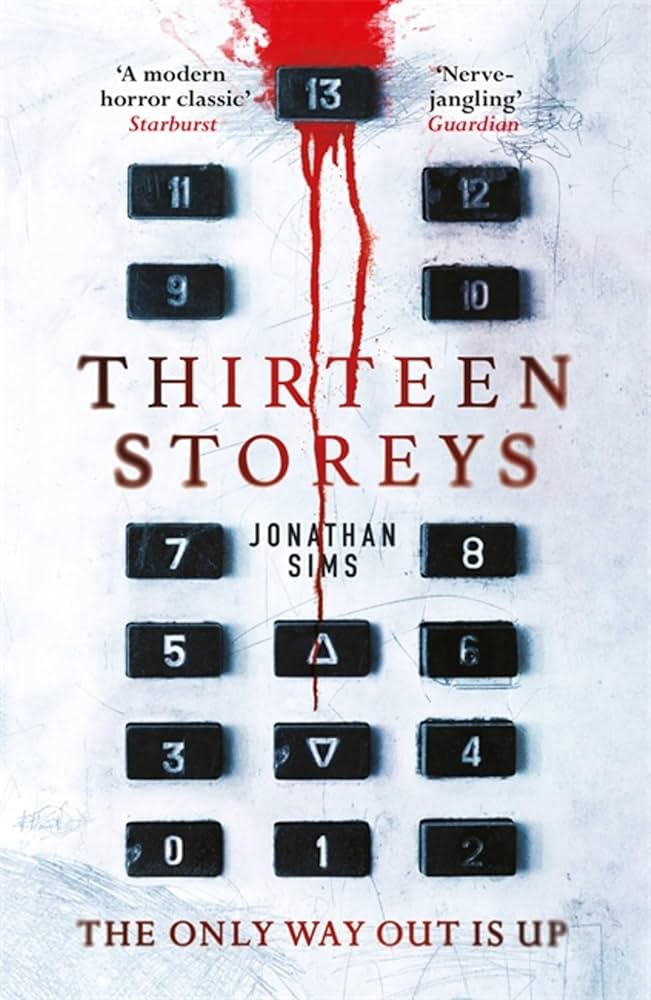
“The ghosts were never the problem”: A Review of Jonathan Sims’ Thirteen Storeys

This is a review literally years in the making. I first listened to the audiobook1 back in, I believe, 2020 when it first came out, and I am not sure I can adequately convey how enthralled I was. I listened to it at home — alone in the kitchen, making tea, or outside shoveling snow off the front walk. I listened at work, alone in the otherwise darkened bookstore before we opened, or in the back office while I stared at spreadsheets and inventory numbers. When I was out front, doing the customer service parts of my job that could not be done while wearing headphone, I resented having to tear myself away. And, when it was finally over — in all its hair-raising, satisfying glory — I felt slightly at a loss for how to fill the silence. I missed the characters and the place and the cadence of the actors’ voices. So I started it again. I am, admittedly, the sort of reader who can truly fixate on stories that appeal to me, and this novel brought it out in all the best ways.

The conceit of Thirteen Storeys is more or less a simple one: an infamous, reclusive billionaire died under mysterious circumstances at a dinner party in his penthouse at a luxury tower block, and none of the thirteen guests — a random assortment of people related to the building, including a small child — were ever arrested for the murder. The novel then offers a series of interconnected horror stories about the guests and the building, culminating in the event itself. This brief description in no way does justice to the brilliance of the book. As with anything, stripped down to its bare bones, it sounds plain and almost derivative. Nothing could be further from the truth.

Before we go any further, I should preface this review by pointing out that Thirteen Storeys comes with every non-sexual content warning you can possibly think of. That said, it is worth all of them. So, gird your loins, and let us proceed.

Continue reading

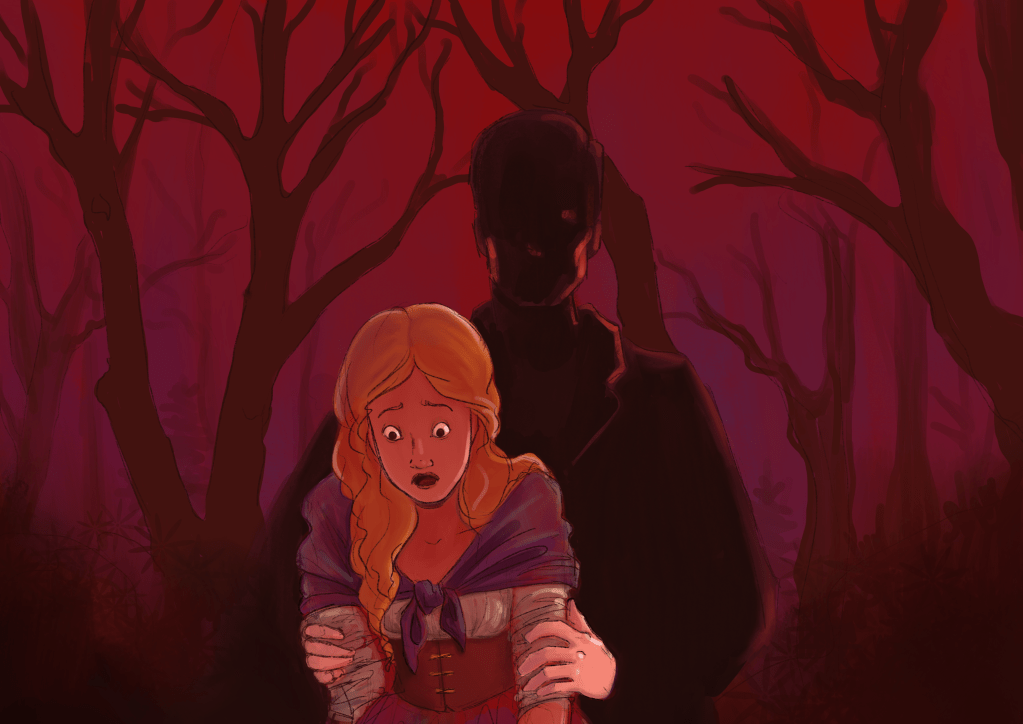
“Come Go Along With Me”: Murder Ballads, Fairy Tales, and the Danger of Following Men into the Woods

“Come listen to my story,” the song starts. “I’ll tell you no lies.”

The scene unfolds: a beautiful young woman steals away into the woods at night. The branches creak overhead, the river rushes somewhere through the trees, and the figure of a man beckons her to an open grave or a watery death. In the dark, the wild birds sing.

It is, as they say, a tale as old as time; one that we have seen play itself out in countless fairy tales, ghost stories, plays, true crime podcast, and — yes — ballads. You may have heard the term “murder ballad” before. But what does it mean? As Madison Ava Helm wrote in the introduction to her thesis on the subject: “The ballad is a tricky minx to categorize.”1 Bear with me, and we’ll do our best.

Continue reading

Terrible Vampire Movies: Subspecies (1991)

Everyone has a cinematic guilty pleasure — the movies you know are really not great, but you love them anyway. For me, it is terrible vampire movies. Their low-budget earnestness often delivers more of what I want out of a vampire movie than any of the big name offerings seem to manage. And, more importantly, they are just plain fun. So, with “fun” as our codeword, here is the inaugural entry in our Terrible Vampire Movies column.

We’re starting with one of my (apologies to Chloe) personal favorites: Ted Nicolaou’s Subspecies.

There are apparently four — soon to be five — movies in this series, but I won’t drag you all that far down the rabbit hole. We will be focusing on the original 1991 film, which I trot out for viewing every October like clockwork. The leaves turn orange, and I have a Pavlovian need to watch it. The basic premise of Subspecies is classic horror movie fare: three folklore students working on their Masters theses come to the small Romanian village of Prejnar to study local vampire stories, only to discover that there is more truth to the legends than expected. So far, pretty much as expected, right? Well, buckle up, friends — it’s going to get a little weird.

Continue reading

A Grain of Salt and a Shovelful of Earth: On The “Twilight Zone,” “The Grave,” and a Lack of Western Ghosts

My favorite episode of The Twilight Zone opens with a scene that even the narration admits ought to be the end. The audience sees a desolate, windswept village, one that the imagery of westerns has trained us to understand is somewhere in the Southwest, likely New Mexico. A man is gunned down in the middle of the dusty street, the shots fired by several of the village men hiding in doorways. After he falls, his body is carried into the jail, and a witness is sent to fetch the wounded man’s father and sister to be with him before he dies.

All of this happens in just a few moments, and is merely the prologue. As Rod Serling says in introduction:

Normally … this would be the end of the story. We’ve had the traditional shoot-out on the street and the Bad Man will soon be dead. But some men of legend and folk tale have been known to continue having their way even after death. The outlaw and killer Pinto Sykes was such a person, and shortly we’ll see how he introduces the town, and a man named Conny Miller in particular, to the Twilight Zone.

Continue reading