Ghost Stories for Christmas

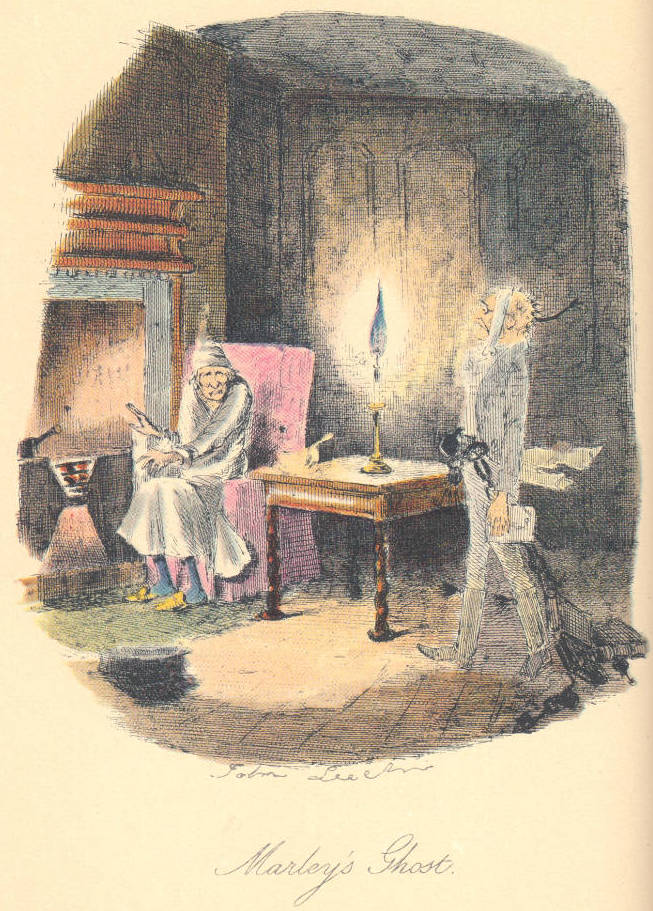
John Leech's original illustration of Ebenezer Scrooge being visited by the ghost of Jacob Marley in A Christmas Carol

Marley was dead to begin with. There can be no doubt whatsoever about that.

And with those immortal words, generations have settled in to embrace the spirit of Christmas — with ghosts. I know very few people1 for whom A Christmas Carol is not an integral part of their idea of the holiday itself. Whether their introduction to it was the text itself, the Muppet version (which actually does include a surprising amount of Dickens’ own words), or any of the myriad other forms and adaptations, its depictions of family and friends getting together in joy, its message of compassion and good will to all mankind, even its nineteenth century trappings of geese and pudding and silly games have all become the markers of the season and the holiday. Yet, for all its good cheer, it is emphatically a ghost story — and a creepy one at that!

Think of the scene when Scrooge, alone in his darkened rooms, hears the sound of Marley’s ghost coming for him:

After several turns, he sat down again. As he threw his head back in the chair, his glance happened to rest upon a bell, a disused bell, that hung in the room, and communicated for some purpose now forgotten with a chamber in the highest story of the building. It was with great astonishment, and with a strange, inexplicable dread, that as he looked, he saw this bell begin to swing. It swung so softly in the outset that it scarcely made a sound; but soon it rang out loudly, and so did every bell in the house.

This might have lasted half a minute, or a minute, but it seemed an hour. The bells ceased as they had begun, together. They were succeeded by a clanking noise, deep down below; as if some person were dragging a heavy chain over the casks in the wine-merchant’s cellar. Scrooge then remembered to have heard that ghosts in haunted houses were described as dragging chains.

The cellar-door flew open with a booming sound, and then he heard the noise much louder, on the floors below; then coming up the stairs; then coming straight towards his door.
Continue reading

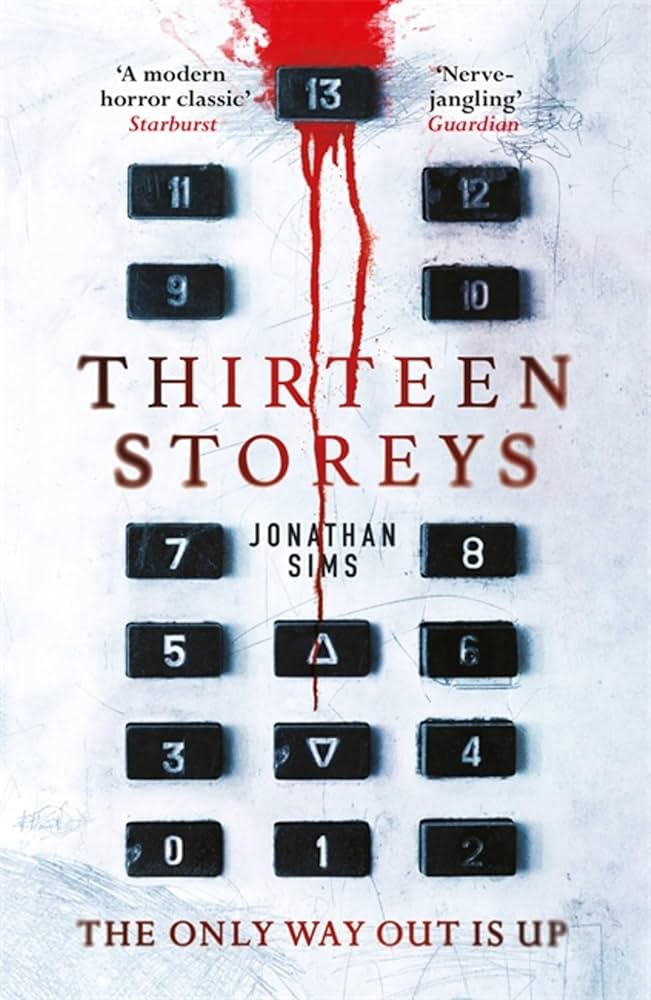
“The ghosts were never the problem”: A Review of Jonathan Sims’ Thirteen Storeys

This is a review literally years in the making. I first listened to the audiobook1 back in, I believe, 2020 when it first came out, and I am not sure I can adequately convey how enthralled I was. I listened to it at home — alone in the kitchen, making tea, or outside shoveling snow off the front walk. I listened at work, alone in the otherwise darkened bookstore before we opened, or in the back office while I stared at spreadsheets and inventory numbers. When I was out front, doing the customer service parts of my job that could not be done while wearing headphone, I resented having to tear myself away. And, when it was finally over — in all its hair-raising, satisfying glory — I felt slightly at a loss for how to fill the silence. I missed the characters and the place and the cadence of the actors’ voices. So I started it again. I am, admittedly, the sort of reader who can truly fixate on stories that appeal to me, and this novel brought it out in all the best ways.

The conceit of Thirteen Storeys is more or less a simple one: an infamous, reclusive billionaire died under mysterious circumstances at a dinner party in his penthouse at a luxury tower block, and none of the thirteen guests — a random assortment of people related to the building, including a small child — were ever arrested for the murder. The novel then offers a series of interconnected horror stories about the guests and the building, culminating in the event itself. This brief description in no way does justice to the brilliance of the book. As with anything, stripped down to its bare bones, it sounds plain and almost derivative. Nothing could be further from the truth.

Before we go any further, I should preface this review by pointing out that Thirteen Storeys comes with every non-sexual content warning you can possibly think of. That said, it is worth all of them. So, gird your loins, and let us proceed.

Continue reading

A Grain of Salt and a Shovelful of Earth: On The “Twilight Zone,” “The Grave,” and a Lack of Western Ghosts

My favorite episode of The Twilight Zone opens with a scene that even the narration admits ought to be the end. The audience sees a desolate, windswept village, one that the imagery of westerns has trained us to understand is somewhere in the Southwest, likely New Mexico. A man is gunned down in the middle of the dusty street, the shots fired by several of the village men hiding in doorways. After he falls, his body is carried into the jail, and a witness is sent to fetch the wounded man’s father and sister to be with him before he dies.

All of this happens in just a few moments, and is merely the prologue. As Rod Serling says in introduction:

Normally … this would be the end of the story. We’ve had the traditional shoot-out on the street and the Bad Man will soon be dead. But some men of legend and folk tale have been known to continue having their way even after death. The outlaw and killer Pinto Sykes was such a person, and shortly we’ll see how he introduces the town, and a man named Conny Miller in particular, to the Twilight Zone.

Continue reading

But What Lurks Without? M. R. James vs. H. P. Lovecraft

It’s sort of strange how omnipresent H. P. Lovecraft is in horror conversations, even now. The legacy of his particular branch of weird is substantial — and, largely, a conversation we are saving for later on. Don’t worry, there is still a lot to say.

A less well-known figure holds a much closer place in my heart: M. R. James.

On the surface, it is strange to compare these two men. James was the father of the antiquarian ghost story. Lovecraft basically created the genre of cosmic horror. And yet, there really is a great deal of common ground. They were, in fact, contemporaries, and died within a year of one another (James in 1936, Lovecraft in 1937). Both wrote stories that took their sensibilities from earlier time periods. Both have had impacts on the horror genre that they never would have foreseen. Both were solitary men whose sexuality is a preoccupation of modern scholars. And, most importantly, both based their horror in a fear of the Outside, of the arcane, and of the forbidden.

Perhaps it’s best to start with some brief biographical notes.

Continue reading