A Definitely Positive Review of Hellboy: The Crooked Man (2024)

When it was first announced that another Hellboy movie was in the works, I was tentatively excited. The comics are, of course, a perennial favorite, as is the Guillermo del Toro version.1 The 2019 movie had one truly brilliant scene2 but was largely an oddly-paced, muddled mess. Still, I never turn down Hellboy, and the title was a promising start. The Crooked Man is a wonderfully spooky story, and I liked the idea of a new movie taking on one of the standalone tales rather than diving into the end game. So, I waited to hear more, and… nothing. Having assumed that the movie — like so many titles — was a project that had simply dropped into the ether, never to be seen again, I forgot about it until people started making noise about a trailer. The trailer looked low-budget but creepy (which, as you all may have noticed, is my favorite kind of horror movie). I went back to being excited.

Then, once again, nothing. No updates, no theatrical release, just radio silence about it being available in the United States.

I will admit, by the time I saw it available to purchase online, I was feeling my doubts. As of sitting down to do so, it had a 29% rating on Rotten Tomatoes.3 Combined with the decision to release it direct to streaming, I was braced for it to be bad. Imagine my shock, dear reader, when it was not bad. In fact, I greatly enjoyed it. It’s not perfect — and we’ll get back to that — but it’s creepy, atmospheric, and fun. And, it feels like the comics. Honestly, go watch it with an open mind and you’re going to have a good evening.

For those of you who are less familiar, here is the basic shape:

While in southern Appalachia in the late 1950s, Hellboy comes across a local resident who has been harmed by a witch. Together with a recently-returned local named Tom Ferrell, who has his own history with the witchcraft and evil in the region, he sets out to look into the matter. Together, they go to bury Tom’s father and confront the local manifestation of the devil — the so-called “Crooked Man”. Sounds simple? It’s a horror movie, friends, you know better than that.

Now, let’s dig in a little more. (A warning: there are going to be spoilers. I will leave out some details, but I will be hitting both the main plot points and things that struck me as being worth some extra discussion. The majority of them are straight from the comic, but there are a few places where the movie differs. Proceed with caution if this bothers you.)

Continue reading

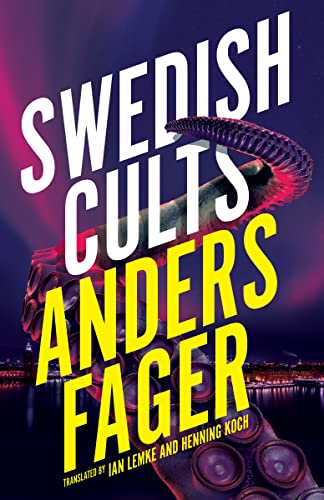
“How Deep the Abyss Really Is”: A Quick Review of Anders Fager’s “Swedish Cults”

Anders Fager’s creeping, ichor-sticky collection, Swedish Cults, begins with a story about, well… a cult. But it’s the kind of cult action I absolutely love, in which there is no great fanfare about all this ritual business, and the cult itself sits almost comfortably in plain sight, a set of practices and traditions that everyone in a community more or less acknowledges as having always been there. “The Furies of Boras” sees a modern set of teenage girls out at a dancehall, at a place where there has always been dancing, and as perennial as teenage girl politics and concerns, as perennial as the dancing, is the thing in the bog waiting for its due.

“Anna closes her eyes, sees primeval swamps behind her eyelids. Swamps and rain and kisses. The Pussycat Dolls’ ‘Don’t Cha’ blares through the speakers. Sofie scans the place. She’s thinking about her history project. There’s a lot going on in your head your final year. Industrialism in the Vastergotland region and bogs and kisses. … Stares at the girls and stares at a telephone pole of a tentacle less than a meter from her forehead. A twitch and she’s dead. Not much fun. And on top of everything she has an essay to hand in.”

All of Fager’s stories have this matter-of-factness, a sense of brains skipping a beat when forced up against the incomprehensible, sliding over hysteria and protest directly into a kind of shock of acceptance. There is something indelibly human about a high schooler in a cannibalistic orgy, watching the lumbering, eldritch swamp-beast she and her cohorts are petitioning, worrying about a history essay she has to write. Such a detail might seem farcical in the hands of a less-keen observer, but Fager knows how to fit the mundane against the outlandish pretty seamlessly.1 His Lovecraftian horrors are glimpsed rather than belabored, appearing obliquely in conversations between two old friends, in the subtle changes in a boyfriend returning from abroad, in a name uttered into the winter air. In his precisely-drawn characters, appearing as sharp as miniatures in the brief space they occupy, we feel lives proceeding mostly normally until, inexorably, they slip into the uncanny; as with Laird Barron’s horror fiction, much of the impact of Fager’s work lies in this dread as things slip away from the familiar with no hope of getting back to the right path.

Valancourt Press, which published this for American audiences, has been doing a lot for weird fiction both vintage and contemporary; their republishing of many of the luridly great titles featured in Grady Hendrix’s delightful Paperbacks from Hell is a tremendous service to an all-too-ephemeral age of horror fiction. I’m really looking forward to checking out many more of their offerings based on the strength of this title alone. 

  1. Definitely to be credited here, too, are his very capable translators, Ian Lemke and Henning Koch. ↩︎

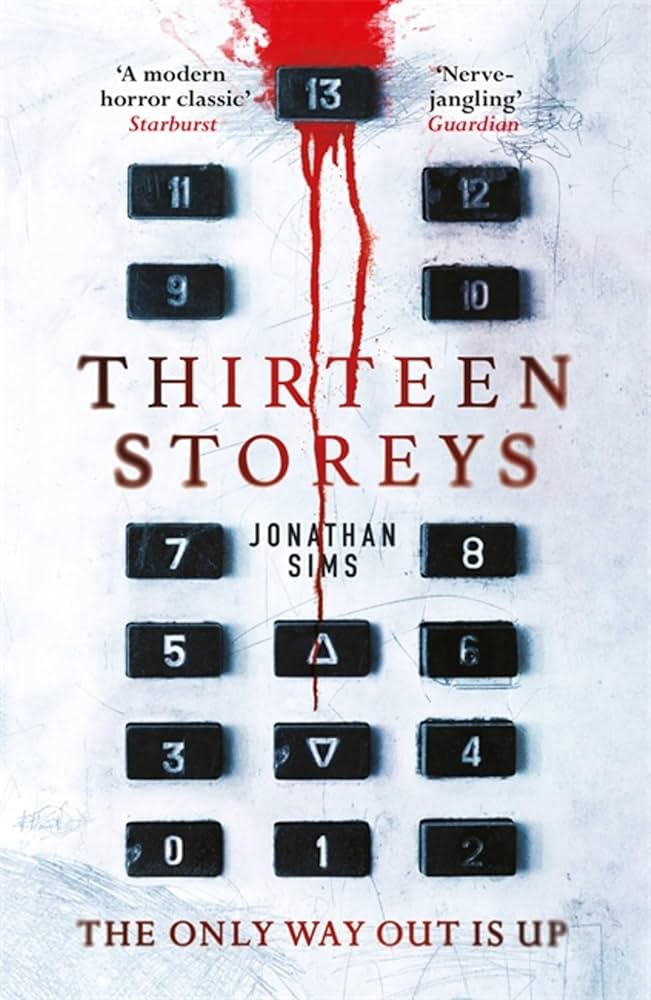
“The ghosts were never the problem”: A Review of Jonathan Sims’ Thirteen Storeys

This is a review literally years in the making. I first listened to the audiobook1 back in, I believe, 2020 when it first came out, and I am not sure I can adequately convey how enthralled I was. I listened to it at home — alone in the kitchen, making tea, or outside shoveling snow off the front walk. I listened at work, alone in the otherwise darkened bookstore before we opened, or in the back office while I stared at spreadsheets and inventory numbers. When I was out front, doing the customer service parts of my job that could not be done while wearing headphone, I resented having to tear myself away. And, when it was finally over — in all its hair-raising, satisfying glory — I felt slightly at a loss for how to fill the silence. I missed the characters and the place and the cadence of the actors’ voices. So I started it again. I am, admittedly, the sort of reader who can truly fixate on stories that appeal to me, and this novel brought it out in all the best ways.

The conceit of Thirteen Storeys is more or less a simple one: an infamous, reclusive billionaire died under mysterious circumstances at a dinner party in his penthouse at a luxury tower block, and none of the thirteen guests — a random assortment of people related to the building, including a small child — were ever arrested for the murder. The novel then offers a series of interconnected horror stories about the guests and the building, culminating in the event itself. This brief description in no way does justice to the brilliance of the book. As with anything, stripped down to its bare bones, it sounds plain and almost derivative. Nothing could be further from the truth.

Before we go any further, I should preface this review by pointing out that Thirteen Storeys comes with every non-sexual content warning you can possibly think of. That said, it is worth all of them. So, gird your loins, and let us proceed.

Continue reading

Terror of the Flesh: Primal’s “Plague of Madness”


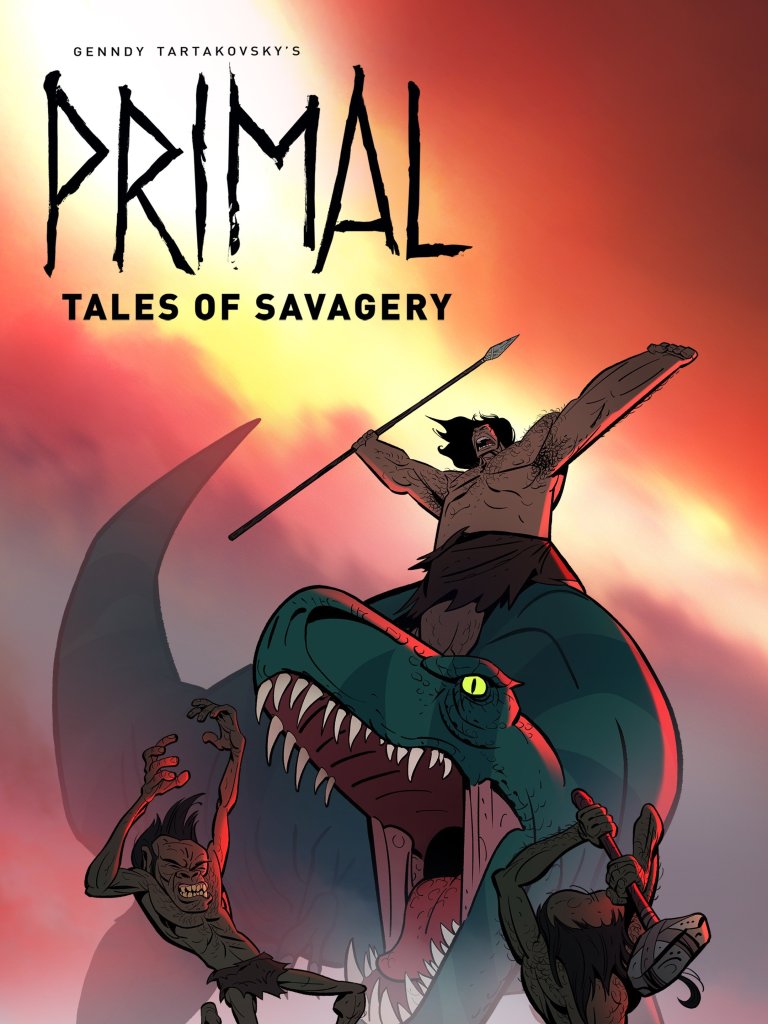
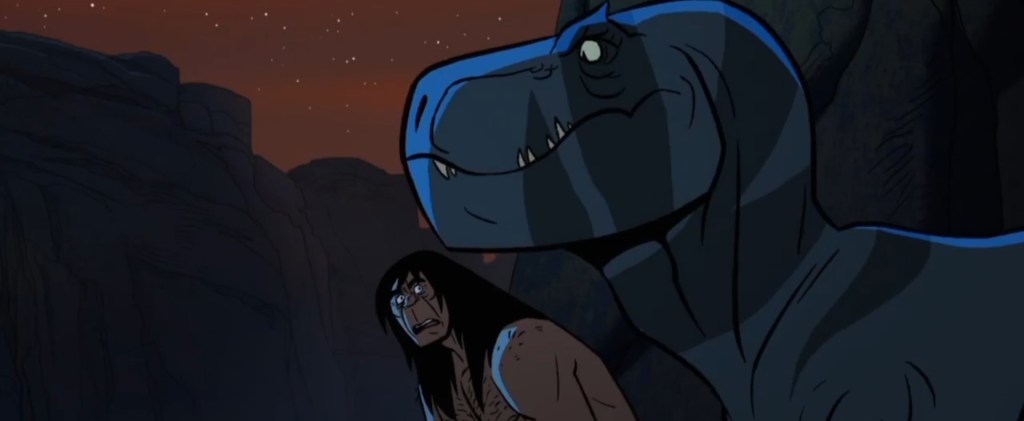
Genndy Tartakovsky’s Primal, his two-season epic animated series featuring the journeys of Spear, a Neanderthal, and Fang, a tyrannosaur, is an incredible achievement in world-building. It’s pulpy, imaginative, emotional, and tense, each episode a remarkably heady and rich tapestry of landscape and character, packing in way more depth than every 22-minute runtime seems able to contain. And the show builds this world with absolutely no words spoken. Tartakovsky’s work thrives on a minimum of dialogue (see Samurai Jack and The Clone Wars at their finest), but Primal eschews it altogether, orienting us toward the world as Spear and Fang see it, as a network of complex interactions between creatures trying to survive an unforgiving existence. Close observation is essential to their success in this world, and so we, too, are keenly attuned to the beings they encounter. We can’t rely on linguistic explanation for what we see, and so are locked into this highly intimate, emotive focus. A lesser filmmaker would stumble at the admittedly very tall order of getting audiences deeply attached to a caveman/t-rex duo, but Tartakovsky knows what he’s about.


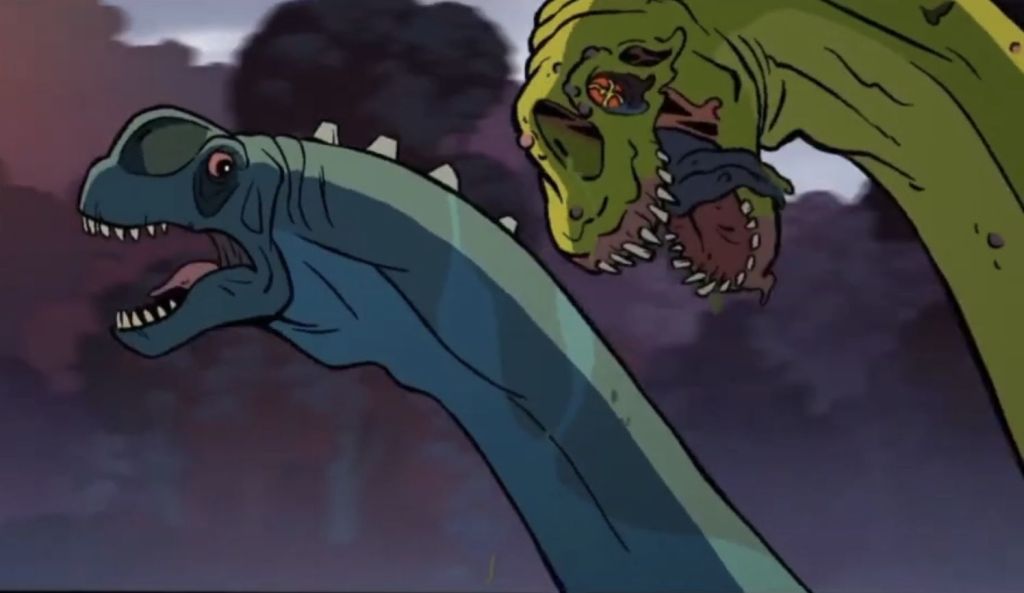
This setting, filled as it is with prehistoric creatures and weird magic, allows for a lot of tension and spookiness, but nothing matches the sheer terror of “Plague of Madness,” an episode in the show’s first season. It encapsulates everything Primal does so well. It’s visually arresting, it communicates the inner lives of the protagonists and of the animals they meet so keenly, and it asks us to face a world before and beyond the explanatory crutch of metaphor. It also answers a question close to the hearts of many horror fans: how do you make zombies scary again?


Easy! Make the zombie a thirty-ton brachiosaurus1.

Oh no.


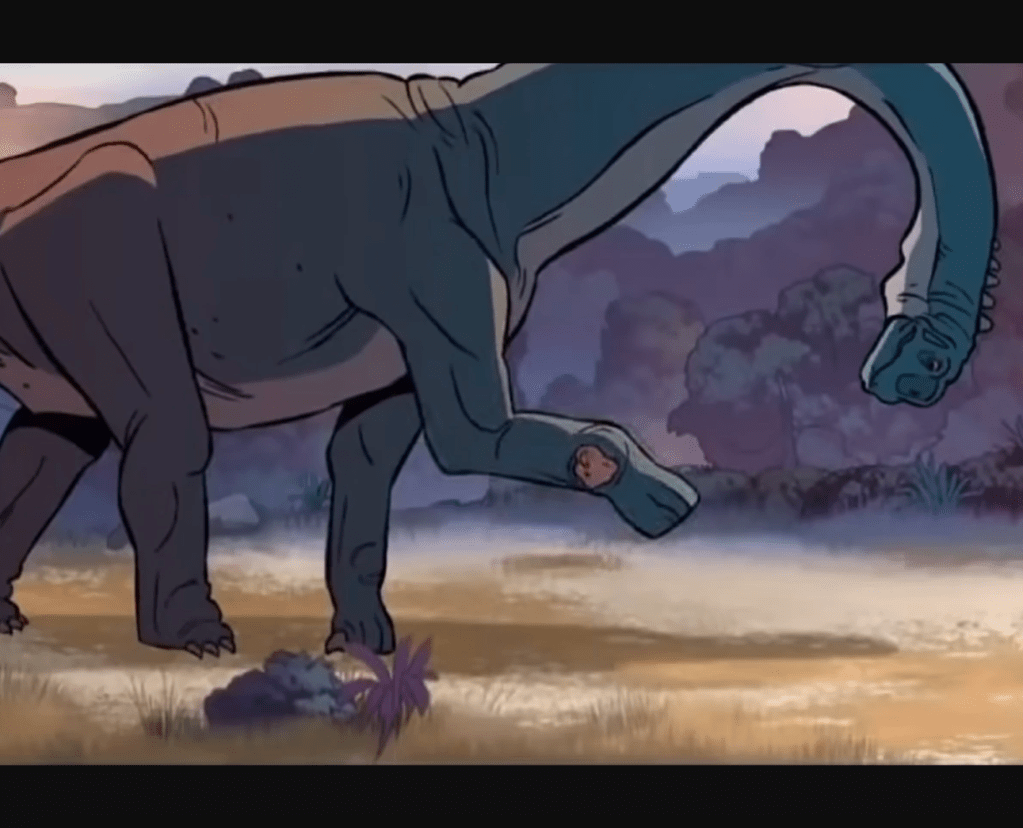
The episode begins with unusual tranquility for the show, with a herd of sauropods peacefully going about their business, grazing leaves, tending their eggs, chilling out in pools. Like all of Tartakovsky’s non-human characters, these creatures are imbued with great inner life, their expressions and body language imparting intelligence, dignity, and gentleness. The bucolic scene is punctuated by an incredibly small, comparatively, intruder- a spastic, mad-eyed, drooling parasaurolophus, staggering with rabid loopiness toward one of the brachiosaurs. A tiny bite from this tiny animal on the giant’s leg is enough to doom this whole scene to an insane hell, but as the brachiosaurus flicks the smaller dinosaur away into a tree, eyeing its death-spasms with cautious worry, it feels impossible that this towering creature could be ruined by this insignificant one. It compounds the sense of dread.

OH NO.


We’re not given much time to dread, however, as the infection takes over the brachiosaurs. We see it struggling toward water, clearly sick, and while we know, in a way, what’s coming, it’s tragically clear the animal doesn’t. It gulps down water in an attempt to alleviate a fever we know is completely unnatural, before violently vomiting blood and succumbing to the full madness of the plague. It’s damn gross, but worse is the now-mindless creature’s rampage against its herd, wherein it breaks backs, tramples eggs, bites and kicks its baffled compatriots into so much pulp. There’s no reason we can see for its sudden, explosive frenzy, but of course there is no reason.


Spear and Fang come across the aftermath of this bloodbath, and even the tyrannosaur is stricken by the carnage. Neither of the protagonists, for all their predatory acumen, would be able to tackle the brachiosaurs, and we see their unease as they wonder what animal is of a size to do so. One of their own, it turns out. Deprived of any other focus for its compulsive violence, the brachiosaurus fixates on the appropriately horrified Spear and Fang, launching an utterly terrifying chase through jungle and down sheer cliffs. The thing just. Won’t. Stop. It’s beyond living, beyond thought, reduced to this juggernaut of intractable hostility and rotting meat. It’s prehistoric Cujo.

My thoughts exactly, guys.


Heightening the tension of the episode is Spear’s understanding of how corrupted and unnatural this creature has become. He is frightened by it in a way we haven’t really seen in the character before, on a seemingly existential level; a nightmare in which he and Fang both succumb to the same affliction as the brachiosaurus, their flesh melting and their minds evaporating, reveals a deeper dread than Spear’s usual concerns about survival. Whatever has afflicted the sauropod is crueler and more utterly annihilating than death. The plague is self-erasing, completely negating what this animal once was, its innately pacific, dignified nature obliterated. At risk is his own inner life, his own keenly felt sense of what he is in the world he inhabits. This plague is worse than death. It’s annihilation.


It’s this intimate focus on individual erasure which makes the brachiosaurus such a satisfyingly scary monster. The deranged brachiosaurus is what we would recognize as a zombie- it’s dead but still ambulatory, it had a soul or an active intelligence which it has lost- but it’s a zombie which stands for nothing else. It serves no commentative purpose because its world matrix has no society to comment on. What’s left is a very distilled, very effective terror, and a very personal one. It also injects pathos back onto the zombie. We understand the mad brachiosaurus as an individual, its condition as upsetting and tragic as it is terrifying. It’s not really fair that this happened to it, and again the spirit of poor Cujo is present. Neither animal did anything to deserve their fates, and we wish they hadn’t suffered them, even as we also really wish they would please, please just die. Spear’s fear of this creature, like ours, is tempered by the same pity. He and Fang lead the beast into a lava field where it blunders into the magma and finally perishes, though not before being fully engulfed into fire and still trying to kill them. As he watches it flail and scream in rage, at last becoming nothing but so much ash, Spear is clearly stricken by the unfathomable, grotesque fate of this creature. There’s no triumph in its defeat, just horrible relief.

A rare instance of the zombie evoking pathos.

I love this show for a lot of reasons, but this one episode is such a stark statement on how horror can function separate from its tendency to be used as metaphor. The brachiosaurus stands for nothing- it is a void, truly Unnatural. By stripping away so many of the trappings of modernity, by focusing on the minute details of character in a rich but rarely human world, Tartakovsky reminds us that fear is far more base than our epistemic habits permit. It’s nothing but itself, hitting at the deep, wordless core of ourselves. Primal. 

  1. Technically, it’s an Argentinosaurus. Visually, the two species are very close, and I think brachiosaurs are more recognizable, so that’s the term I’ll be sticking with. It’s not scientific, but neither are zombie dinosaurs. ↩︎

“If I could name the nameless thing”- A Review of “The Monstrumologist”

With no small bit of surprise, I recently realized that one of my very favorite novels of Gothic horror, Rick Yancey’s utterly excellent The Monstrumologist, turned ten this September. This was unnerving because ten years can slip by awfully fast, and I really hadn’t perceived that it had been that long, but also because this book, and its three equally superlative sequels, doesn’t feel only ten years old. In recommending The Monstrumologist to people, which I do, emphatically and to anyone who even half-admits to sort of liking horror, I use Yancey’s brilliant sense of time-specific language as part of my sales pitch. It’s not a simple thing to recreate the tones of late 19th century fiction, and yet that’s exactly what Yancey does so well in these books. The effect goes beyond mere pastiche; The Monstrumologist trades on its author’s seamless feel for late Victorian mores, fears, attitudes, and weaknesses to construct a story which reads like something old and feels bracingly fresh. The Monstrumologist can claim descent from the grim offerings of Bram Stoker, Robert Louis Stevenson, and Arthur Conan Doyle, but at a remove of a century or so, Yancey’s free to spiral into even deeper and darker terrain than did his forerunners. It’s the most satisfying sustained horror series I’ve met. 

I think there’s a case to be made for Victorian horror pioneering the “found footage” trope, in which a story is presented as merely discovered, not fabricated. Dracula is a series of letters, diary entries, and news items, a novel certainly, but one whose impact can be attributed in part to its delivery as a relation of true events. Though they trend less toward the horrific, Conan Doyle’s Sherlock Holmes stories are presented as factual events. We tend to see this motif a lot in contemporary horror films, the most famous example still being “The Blair Witch Project,” but it’s less common now in print. The Monstrumologist, true to its core to its Victorian ancestry, resuscitates found footage in text to wonderful effect. Yancey himself, in the book’s prologue, claims to have been given the folio journals which comprise the bulk of the series, the records being the only personal effects of an elderly man who recently died, unclaimed by any family, in a nursing home. Who this man really was remained unclear to the staff of the facility, and, indeed, Yancey isn’t much enlightened himself by the horrifying contents of the man’s journals. None of this can really have happened, right? Of course not. But the great fun of found footage, when it’s treated as a useful imaginative tool and not merely a cheap way of knocking out a couple lazy movies, is that it allows us the thrill of doubt. Of course monsters aren’t real. But if… 

The journals are those of Will Henry, orphaned in the late 1800s in the New England town of New Jerusalem. After the death of his parents, he’s left in the questionable care of Pellinore Warthrop, who treats the boy less as a foundling and more of a free assistant. Warthrop is a natural philosopher, and his specialty is monsters. Real, honest-to-God monsters. A hardened materialist, Warthrop scoffs at the supernatural; his creatures are flesh and blood, warped relics of evolution which most of humanity has been allowed, mercifully, to forget or ignore. The doctor is as passionate about his subjects as he is callous toward Will Henry, and much of the four books’ emotional fulcrum hinges on their wary, difficult attempts to provide what the other needs. As he ages into a teenager, Will hardens from a grief-stricken child desperate for the approval of the only adult left in his life into a much more worrisome creature indeed, something slightly more akin to the beasts he and Warthrop routinely pursue. It’s a theme which isn’t new- those who hunt monsters should be wary lest they become monsters themselves- but it shifts in unexpected directions; the narrative’s ultimate conclusion is murky and unsettling in the best possible way, leaving you turning back to the beginning in sudden trepidation. Another great trick of a story presented as “true”- you realize you can’t trust your narrator. 

Thematically satisfying, the novels also boast a truly memorable cast. Warthrop’s surprisingly gentle mentor Von Helrung is a more relaxed Van Helsing; the anonymous, ubiquitous, and usually hapless Victorian orphan gets a sharp remake in the vengeful Malachi; John Kearns, a mysterious acquaintance of Warthrop’s, is one of the most memorably charming psychopaths I’ve encountered in fiction. And then there are the monsters. Yancey writes very good monsters. The first book features the anthropophagi, headless, man-eating nightmares with maws in the middle of their abdomens (not many novels reference Herodotus, but really, more should). The amorphous wendigo plagues the second book, a metaphysical nightmare for Warthrop, who doesn’t hold that nature is influenced by the unseen. Mongolian death-worms, parasitic infestations, and primordially massive serpents skulk through the pages, often unseen but always felt, casting the actions of the human players in a disturbingly ambiguous light: in a world which permits human beings to be dismembered and crafted into nests for fledgling monstrosities, what sense does individual morality really hold. It’s a deliciously haunting question, one with which Victorian naturalists, confronted with the irrefutable truth of the theory of Darwinian evolution, absolutely wrestled. Yancey cranks up the intensity of that struggle by contrasting his human characters with not only the bald insensitivity of nature but with the genuinely inhuman, Nature permitting no special pleading for humanity at all. It’s a struggle further tangled by the inhumanity of many of the superficially human characters. The uncovering of evolution by natural selection forced the Victorian mind to fundamentally reconfigure itself to the impersonal reality of a universe which does not particularly care for mankind; Yancey, with both empathy and clear-eyed hindsight, depicts a cast of informed, intelligent men and women wrestling mightily with the knowledge that they are not at the summit of any teleological ladder, and it’s both unnerving (don’t we still think of ourselves at the top of the evolutionary heap?) and affecting. 

The Monstrumologist was never a huge seller, but those who do read it are passionately committed to it. I always encourage readers to give the series a shot, because to know it is to love it. Its cumulative impact is wonderfully grim and lovely, its writing densely grotesque and beautiful. The Monstrumologist looks the unnamable in its hideous face and acknowledges the very human attempt to name it. It’s a series which celebrates our determination to make sense of our world, and one which isn’t afraid to recognize that the effort is poignant, bloody, and, sometimes, very futile indeed. 

A Separate Reality: Five Years of “P.T.”

In just over a week I’m going to be playing “Death Stranding,” the long-gestating creation of video game auteur Hideo Kojima. That feels like something of a remarkable statement, given just how long and how well-documented that period of incubation has been; audiences haven’t even touched this game yet, what it’s really about is still debatable, and yet I feel like we’ve been living with and around it forever. Accusations of overhype are of course being lobbed around, maybe not without reason, but I’m ignoring them with steely and perhaps unwarranted loyalty- “Death Stranding” has come to mean a lot to me, an eerie, ominously resonant glimpse at what we might be able to expect from video games in terms of narrative innovation and formal experimentation. And it also means a lot to me because I perceive it as the spiritual if not the genetic descendant of the purest example of horror in gaming I’ve ever seen. 

Five years ago Kojima, working at the time with Konami, released the anemically named “playable teaser” (it quickly and mercifully became known as “P.T.”) for their upcoming project, “Silent Hills.” A new entry in a horror franchise which has long been associated with psychological distress rather than endless encounters with hostile monsters, “Silent Hills” would have had a respected and long pedigree; the games lean in on unsettling imagery and create a lingering sense of dread by crafting stories around the horrors we form and carry with us. Alas, it was never meant to be. Kojima and Konami’s partnership dissolved with deep animosity on both sides, and “Silent Hills” was scrapped. There’s a part of me that feels like this hardly matters. It’s fun to speculate on the shape this game would have assumed (open world horror? branching, butterfly-effect storytelling? randomly generated?), and its status as never-was-and-never-will-be also lends the title a sort of mythical gilding- we can dream that it was going to be the greatest horror game ever, and because it doesn’t exist, it always can be. Reality need never get in the way. But in the end, “Silent Hills” stands as incidental to what we got with “P.T.”. That game, and I won’t call it a demo because that just denigrates the completeness of the thing, was as close to perfect as reality tends to deliver. 

As an aside, and before going any further, I debated whether to include a detailed description of what “P.T.” entails in terms of gameplay, ultimately deciding against it. Every summation I tried to hammer out felt labored and effortful, and the game is emphatically neither of those things. There are excellent Let’s Plays, all of which capture the confining and instant dread “P.T.” evokes, and those with commentary certainly demonstrate how universally terrified we all were by the game. 

I love horror, and I love video games, and they feel like they were made for each other. Games make the player a coauthor of the action they contain; in assuming control of a character, we as players are responsible for participating in the narrative of the game in a way which feels far more intimate than would watching a character carry out actions in a movie or a novel. There’s a permeability of consciousness there which feels ideally suited for horror, as horror seeks to provoke an aesthetic response which shocks and unnerves us. So often, however, games with a claim to be horror titles do little more than occasionally dress up as such. A game will throw some monstrosity at me, and for a while it’s tense, until I figure out how to evade, defeat, or otherwise vanquish said beastie. It can be an exciting feeling, as it requires me to hang in there and persist, but it could then be ages before anything remotely frightening again happens. Games like this feel like the interactive equivalent of watching a horror movie which falls back on whiplashing its audience with jumpscares. Stressful, sure. Scary, no. And, finally, just kind of exhausting and disappointing. 

“P.T.” does not have mere trappings of horror. “P.T.” is not occasionally scary. This game creates an atmosphere so oppressively terrible, from which we want so keenly to escape, as to be nearly unbearable. Every element and design choice is calculated to produce that effect of suffocation; the claustrophobically narrow first-person camera; the restriction of action to moving forward and zooming in on the environment only, when our inclination is most strongly to look away; the cyclical looping of this one hallway and the persistent fear of what could be waiting around the corner. Most commentators, fairly, focus on that appalling, reincarnating hallway as “P.T.”’s cleverest and most effectively horrifying feature- it’s so economical and so nasty in that simplicity- but I’d contend that its sound design should rank as high. Upsetting and incessantly destabilizing, we’re as eager to escape the noise of this place as much as we are the sight of that damned hallway. The very banality of its setting, a suburban home, makes what “P.T.” does all the more unnerving. Horror creeps into places where we expect nothing to go awry. Like the aforementioned parade of jumpscares, if we anticipate where we’re about to encounter the frightening we lose our sensitivity to it. For horror to be something more than an exaggerated startle reflex, it has to infect something unforeseen, and “P.T.” takes the trope of the haunted house- a potent trope because it feeds our dread of something unclean in our private spaces- and spins it up into something almost Dantean. The game’s world is a kind of purgatory, from which deliverance is possible, but the questions it refuses to answer make that escape, if managed, feel ominous rather than triumphant. Who are we in this game- are we responsible for all these reports we hear on the house’s radio of carnage? Are we the victims of it? Did they even happen in this house? We never know and never really can, which makes our ugly suspicion of complicity as players all the more insidious. 

Beyond the sheer ungodly frightfulness of the game, “P.T.” managed to do something else I find fascinating. The determined player could escape the confines of the game’s hallways, but they only escaped to the arguable freedom, presumably, of Silent Hill, a liminal locale to say the least and one of dubious existential definition. But the game itself slipped its leash as a virtual construction. Its release was so strange, what it was so difficult to nail down, and how we were meant to actually solve the house’s riddle so obtuse, that it quickly spawned its own urban mythology. In a weird way, conversations about “P.T.” reminded me of those about MissingNo., a supposed glitch in the very first generation of Pokemon games which yielded players who caught it a bizarre mutant almost-Pokemon and which required a highly specific ritual to conjure it into being. I could, as a kid, never determine if MissingNo. was real, nor could I account for how, in my pre-internet mid-90s life, I even knew of its possibility, but the idea had a hold on me. It was so eerie to think about games as having their own paranormal relics, their own ghosts, and it was even odder for me to consider what fascination this one pseudo-creature held for me and my friends. Like all the most disquieting urban legends, it was impossible to trace our knowledge of it. Evidently, there were a few different methods of beating “P.T.”, if beating it was really what we did, but those methods, from everything I’ve read, varied considerably from one another. It could be that there were a few viable solutions, but maybe not- maybe there was only one. How these enigmas were pieced together involved a lot of frenzied rumor and internet chatter, but unlike with so many other games which give up their secrets after tireless prodding and datamining, “P.T.” never lost its air of inviolate creepiness. It continues to reveal the depths of its oddities, showing us just how far its commitment to alarming us went, but its whole remains mysterious, self-contained. 

Since its release and subsequent, inglorious execution (part of Konami’s parting shot at Kojima resulted in yanking “P.T.” from the PlayStation store, leaving anyone who hadn’t downloaded it or who had deleted it from their consoles out of luck- it’s gone for good), many games have attempted to make the most out of what “P.T.” introduced. For indie developers especially, that looping environment trick is a godsend, as it is wildly cheap to program and even in the most obvious knock-offs still can cause of a tingle of that original trepidation. “P.T.” inspired such a wave of production of small-scale horror games that I was tempted to doubt its long-term potency- would the game still be as scary as it had been initially after five years of playing and watching its offspring? Yes- yes, it absolutely is. Perhaps because it did craft its own, boundary-defying identity, “P.T.” has a weight and power all its own. And it’s a game which, in a sly, uncanny way, acknowledges us as players- it’s aware that we’ve become involved in and  liable for whatever horror is unfolding around us, and that the easy way out (just stop playing, turn the damn thing off) no longer feels like genuine rescue. 

At one point in the game, a voice, one of the few we meet, tells us: “I walked. I could do nothing but walk. And then, I saw me walking in front of myself. But it wasn’t really me. Watch out. The gap in the door, it’s a separate reality. The only me is me. Are you sure the only you is you?” It’s far more than a wink-at-the-camera synopsis of what the game is doing- it’s a quietly chilling comment on what games can do, introducing us to a layering of consciousness we’re not likely to find anywhere else. In the best games, it’s impossible to feel as though the only you is you. We’re inhabiting ourselves and our own histories, identities, and consciousnesses. And we’re also inhabiting the character we play in the narrative before us. “P.T.” is a concentrated, disorienting exercise in polydimensionality, and there’s no better delivery system for such an experience than horror. 

I still don’t know what exactly we’re getting with “Death Stranding.” It might be best, actually, just to accept that it might be nothing exact at all, that the very murkiness of its nature will be part of its appeal and its strength. “P.T.”’s elastic, transcendental success had so much to do with how we as players were compelled to seek each other out as we attempted to unravel its secrets; “Death Stranding” seems to be about the debilitating nature of isolation and the critical importance of human connections, both to each other and to our environment. It’s hard not to see the evolution from the one, an intensely disquieting exercise in singular confinement, to the other, wherein our sole aim as players appears to be one of reaching out and reestablishing the ties that bind. It feels natural. After all, for horror to really do its trick, we need to be offered a way out of it.