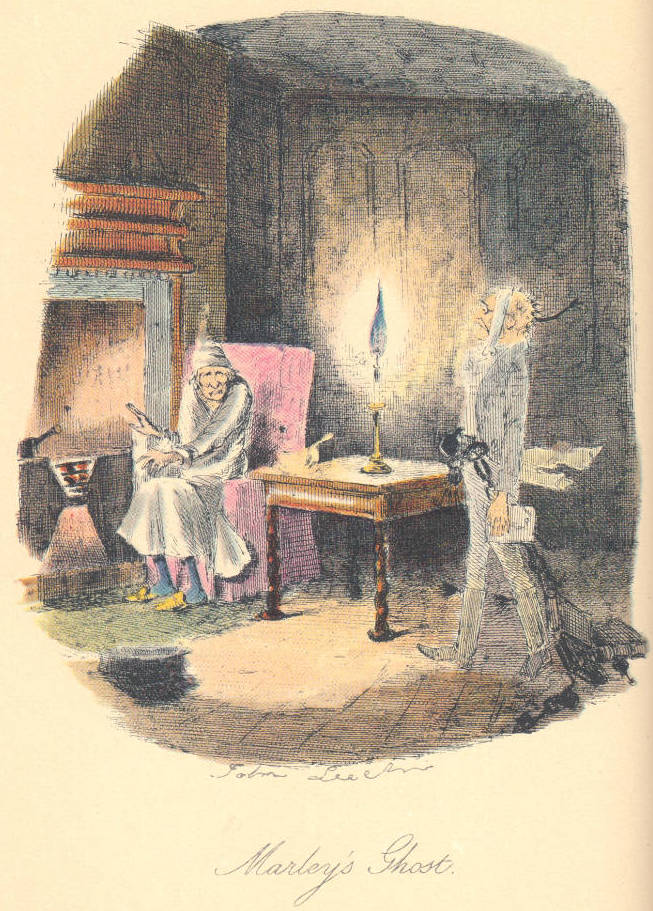
Marley was dead to begin with. There can be no doubt whatsoever about that.
And with those immortal words, generations have settled in to embrace the spirit of Christmas — with ghosts. I know very few people1 for whom A Christmas Carol is not an integral part of their idea of the holiday itself. Whether their introduction to it was the text itself, the Muppet version (which actually does include a surprising amount of Dickens’ own words), or any of the myriad other forms and adaptations, its depictions of family and friends getting together in joy, its message of compassion and good will to all mankind, even its nineteenth century trappings of geese and pudding and silly games have all become the markers of the season and the holiday. Yet, for all its good cheer, it is emphatically a ghost story — and a creepy one at that!
Think of the scene when Scrooge, alone in his darkened rooms, hears the sound of Marley’s ghost coming for him:
After several turns, he sat down again. As he threw his head back in the chair, his glance happened to rest upon a bell, a disused bell, that hung in the room, and communicated for some purpose now forgotten with a chamber in the highest story of the building. It was with great astonishment, and with a strange, inexplicable dread, that as he looked, he saw this bell begin to swing. It swung so softly in the outset that it scarcely made a sound; but soon it rang out loudly, and so did every bell in the house.
This might have lasted half a minute, or a minute, but it seemed an hour. The bells ceased as they had begun, together. They were succeeded by a clanking noise, deep down below; as if some person were dragging a heavy chain over the casks in the wine-merchant’s cellar. Scrooge then remembered to have heard that ghosts in haunted houses were described as dragging chains.
The cellar-door flew open with a booming sound, and then he heard the noise much louder, on the floors below; then coming up the stairs; then coming straight towards his door.
Classic Gothic horror, of the finest quality! A ghost story for Christmas, indeed. While it may seem strange to many modern readers, Dickens’ A Christmas Carol was hardly alone in the pantheon of Christmas ghost stories. It was not even the only one ever written by Dickens himself.2 The book, in fact, belongs to a long tradition of telling ghost stories at Christmas — a tradition that by the nineteenth century had turned into a cornerstone.
Washington Irving, in his 1820 essay “The Christmas Dinner” described this scene from a merry Christmas celebration spent in England:
“When I returned to the drawing-room, I found the company seated round the fire, listening to the parson, who was deeply ensconced in a high-backed oaken chair, the work of some cunning artificer of yore, which had been brought from the library for his particular accommodation. From this venerable piece of furniture, with which his shadowy figure and dark, weazen face so admirably accorded, he was dealing out strange accounts of popular superstitions and legends of the surrounding country, with which he had become acquainted in the course of his antiquarian researches.”3
The parson and other guests proceed to regale them with a host of local ghost stories, many featuring a favorite local ghost — the spirit of a crusader knight interred nearby.
Gathering around the fire in the long nights of winter to tell spooky stories is so long-lasting a pastime that I think historians would be hard-pressed to actually put a date on it. It also transcended class and education — everyone could relate a ghost story that had heard locally, or invented on the spot. Then, as both literacy rates and cheap publications boomed in the nineteenth century, more options were available to the population at large. Magazines like Household Words, which published stories like Elizabeth Gaskell’s Cranford, ran special editions for Christmas that featured ghost stories. Indeed, Household Words published Mrs. Gaskell’s wonderfully eerie “The Old Nurse’s Tale”4 in its 1852 special — which came in between installations of Cranford.
By the turn of the century, the practice of telling ghost stories at Christmas was certainly (and famously) continued by the master of the British ghost story himself, M.R. James. Though the first collection of his stories to be distributed in publication was released in October of 1904, it comes with its own origin story at the winter holidays. By all accounts, each story was first read out by James to his friends on Christmas Eve. They would all gather round the fire with glasses of sherry and, by the light of a single candle, and listen to a new spooky tale.
James’ ghost stories, which feature haunted items of antiquity, lost scholars and antiquarians stumbling onto dark happenings, and strange moments of the uncanny, are the perfect stories for this sort of setting. They may not be flashy, fast-paced, or violent, but they have a wonderful cozy spookiness for them that speaks directly to being part of a Christmas Eve tradition amongst a group of friends.
It is a tradition that has continued even to the modern day. The BBC’s A Ghost Story for Christmas, which ran an episode each year from 1971 through 1978, offered adaptations of several tales from M.R. James and one from Dickens (unsurprisingly “The Signal-Man”). It was revived in 2000 as Ghost Stories with Christopher Lee (hosted by the actor in question5), and then again under its original purview with new episodes in 2005 and 2006. These adaptations, particularly the original series from the 70s, rightfully hold cult icon status.
A Ghost Story for Christmas was the brain child of the director Lawrence Gordon Clark. “Ghost stories were a tradition in my family. Dad used to read M.R. James to us as children,” he told Smug Film in an interview. The idea came about while he was working for the BBC making documentaries. He explained: “I was desperate to make drama films, and I thought that the Christmas Ghost Story was a good idea for television, so I sent up a copy of M.R. James’s Ghost Stories with a marker on The Stalls of Barchester to Paul Fox, who was then Controller BBC 1, and suggested I make it for him. To my amazement and considerable alarm, he said yes, and I was left with a ghost story to write, produce, and direct for next Christmas, in between my regular duties as a documentary maker. ‘Bliss was it in that morn to be alive…’ Any young filmmaker who’s going off to make a film with complete freedom and a great cast and crew will know the joy I felt.”6
As Paul Cornell wrote in Uncanny Magazine: “The 1970s Ghost Stories at their best are ambient horror, designed to be watched late after the festivities, panoramic views of a slightly threatening countryside with the only sound the wind buffeting one’s ears. We’re no longer inside with BBC variety stars or at James’s Cambridge hearth. We’re not even at our hearth with those bare pages. We’re outside, in the liminal space of Christmas, when something is coming but our pagan hearts might wonder what. We’re slightly away from the fire. For a cosily defined while.”7
The first episode to air, in 1971, was an adaptation of James’ “The Stalls of Barchester Cathedral.” In it, a scholar comes across papers that had belonged to Archdeacon Haynes. It quickly becomes apparent that Haynes had murdered his predecessor to gain his position, and subsequently became haunted by a curse on the carvings in Barchester Cathedral, which had been made from the wood of the old “Hanging Oak.”
The Ghost Story For Christmas episode “The Stalls of Barchester” was surprisingly faithful to a story that should have been difficult to adapt for screen; and faithful to great effect. Simon Farquhar wrote that it was “a little miracle of television, a labour of love made on a tiny budget with skill and care. The ecclesiastical setting and music (not to mention a flurry of snow in a woodland scene) make it easily the most Christmassy of the films, but despite that the story is in no doubt that even in the season of goodwill, there will be no rest for the wicked.”8 It was an exceedingly well crafted short film, one that both set the stage for the future episodes, and continues to hold up remarkably well at a remove of fifty years.
Part of the efficacy of these adaptations is down to Clark’s meticulous filmmaking vision, his careful selection of locations and cast, his storyboarding of every scene before it was shot. A great deal is also owed to his respect for M.R. James as a storyteller. As he said of the author: “James has a genius for imbuing objects, usually from the past, with implacable malignity: the bronze whistle in Whistle and I’ll Come to You, the Saxon Crown in A Warning to the Curious, the runes in Casting the Runes.” He continued by noting his respect for James’ equal genius for “combining genuine history and folklore with the supernatural and so making it more frightening and believable.”9 Clark understood the feeling and mystery of the original stories, understood how much they banked on atmosphere and setting to create their eeriness rather than jump scares or blood. And, he was willing to try interesting filmic techniques to get the effect he wanted.
The episode based on “A Warning to the Curious” is in some ways almost like a silent film. It uses the harsh, wintry lighting of the cold seaside and interesting camera angles to emphasize its unsettling mood. Its use of light brings to mind the silent films of German Expressionism, and implies as much as it outright shows. “Warning” took more liberties than most of the others with the original story, but more than delivered in spirit.
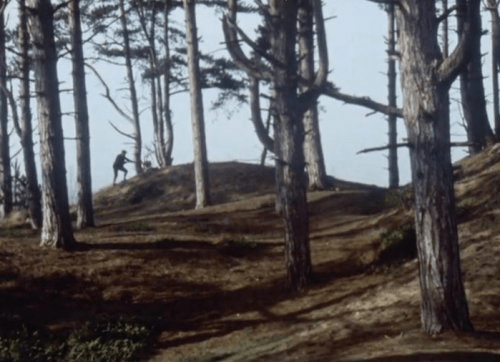
That same interest in using light and interesting camerawork was on display the following year in “Lost Hearts,” particularly “exemplified by a stunning shot of sunbeams reflected in a river. Elsewhere the land is romantically sinister, in an establishing shot of nightfall in the grounds of Abney’s house shot through a spider’s web, or picturesque in the joyous depiction of Stephen’s birthday as he flies his kite on a hillside to the tune of Vaughan Williams’s ‘My Bonny Boy’. No other film in the series, not even A Warning to the Curious, celebrates the English landscape so candidly.”10 This story — uniquely disturbing both in its original story and in its adaptation — follows a young orphaned boy taken in by an elderly cousin, who finds himself plagued by the silent warnings of two ghost children, previously murdered by that same guardian. It is truly unsettling.
As many people have noticed, television is a medium well-suited to ghost stories in terms of its intimacy. It requires its audience to gather together in a group, in a domestic setting, around the source of the story. A Ghost Story for Christmas used that perfectly, and that is part of its enduring appeal. But that does not mean that the tradition has solely migrated to the small screen — it is still alive and well in a literary sense as well.
In recent years, the British Library has begun publishing a series of books called Tales of the Weird — anthologies of classic and forgotten stories of ghosts, monsters, and other strange occurrences from the nineteenth and twentieth centuries.11 As of my writing this article, they have four separate books of Christmas ghost stories, and a fifth of stories for the winter solstice. In America, the independent horror publisher Valancourt Books has likewise put out five collections of Victorian Christmas Ghost Stories.12 I cannot recommend all of these books highly enough. They share stories from famous authors like Charles Dickens and Algernon Blackwood, from once-famous authors like Amelia Edwards and Florence Marryat, from now unheard-of authors like Celia Fremlin and James Skipp Borlase — even some modern stories find their way into the mix.
And, the thing that is perhaps most remarkable about the collections is the way they prove that the appetite for something fun and a little spooky at the holidays remains. There is an inherent nostalgia to both the holidays and ghost stories that I think makes them a very good match, even beyond the atmosphere of long, firelit evenings. Both have strong roots in personal and cultural traditions, both look to bring something of the past back to the present (for good or ill). And, as Paul Cornell pointed out, they give us a small, healthy dose of our wild, pagan roots. Cozily, and in time for bed.
It’s a tradition that I personally intend to continue. With that, I wish you all a very merry Christmas and a happy New Year. I hope you all have a chance soon for a cozy evening with a warm beverage and a good ghost story.
- Said with the acknowledgement that I live in New England, so this is entirely from anglophone perspective. ↩︎
- I would argue strenuously that A Christmas Carol and “The Signal-Man” are the only ones you need to read. That being said, you should take that with a grain of salt as I am not a particular fan of Dickens’ writing, and reserve a special dislike for The Chimes. ↩︎
- “The Christmas Dinner,” published in The Sketch Book of Geoffrey Crayon, Gent. (1819-1820), Washington Irving — a collection most famous for “The Legend of Sleepy Hollow” and “Rip Van Winkle” ↩︎
- “The Old Nurse’s Tale” starts off an impressive number of 20th and 21st century collections of Victorian ghost stories, and it deserves its place in every one. If you have not read it yet, you are in for a treat — it is a classic English ghost story in every way. ↩︎
- As a fun aside: Christopher Lee had actually met M.R. James, and was a definite fan of his work. One wonders, after a point, if there was anyone in the literary world of the 20th century that Christopher Lee had not met. ↩︎
- “An Interview with Lawrence Gordon Clark, Master of Ghostly Horror” Smug Film ↩︎
- “The Telling Silence of A Ghost Story for Christmas“, Paul Cornell, published online in Uncanny Magazine, 2023 ↩︎
- “Ghosts of Christmas past: M.R. James, Lawrence Gordon Clark and A Ghost Story for Christmas”, Simon Farquar, BFI, 2015 ↩︎
- “An Interview with Lawrence Gordon Clark, Master of Ghostly Horror” Smug Film ↩︎
- “Ghosts of Christmas past: M.R. James, Lawrence Gordon Clark and A Ghost Story for Christmas”, Simon Farquar, BFI, 2015 ↩︎
- You can see a list of available titles here. ↩︎
- Valancourt Books website is here. ↩︎
 the shadowes are icumen in