
Come. It is time to keep your appointment with the Wicker Man.
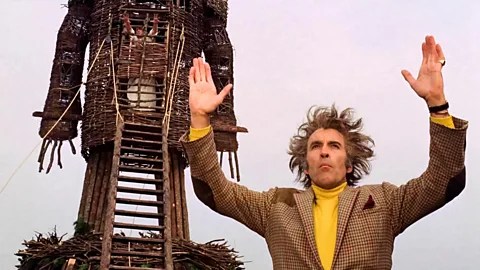
Those words, uttered in the stentorian tones of Christopher Lee, echo through the history of horror cinema. And it is, indeed, time that we come to The Wicker Man. It, alongside The Blood on Satan’s Claw and The Witchfinder General, makes up what is often termed “The Unholy Trinity” of folk horror. It is the Ur Text of the genre. The sharp-eyed among you may have noticed that even the name of this website is an homage to the film, and its stunning final scene.
Full disclosure before we begin: I want to like this movie so badly. I can’t say that I actually do. I am, in the truest sense of the word, deeply ambivalent about it. There are moments that I think are perfect. The shape of it appeals to me immensely. The rest of the time it is weirdly groovy, kind of a mess, and feels like it gets in its own way.
None of this has stopped me from watching it multiple times, trying to nail down what about it remains compelling. And, clearly, I am not alone in being intrigued. There is a wealth of writing about The Wicker Man, ranging from densely scholarly essays to enthusiastic rambles to harsh film criticism. But we do all keep coming back to Summerisle.
While the imagery and afterlife of the film are ubiquitous, I’m not sure how many people have actually seen it. So, we are going to take a moment for a brief synopsis.1
The Wicker Man opens with a surprisingly upbeat recording of “Corn Rigs and Barley Rigs”2 as we follow a small seaplane coming into a lovely spring day on a remote Scottish island. The puritanical Sergeant Howie (Edward Woodward) of the West Highland Police has arrived on Summerisle — an island community that is technically private property, belonging to Lord Summerisle — in response to a letter about a missing girl. He shows a photo of the girl, Rowan Morrison, to a gathering of visitors at the dock. He is told that they have never seen the girl before, and that there are no children missing on the island. When he persists that there must be a missing girl, they direct him to May Morrison, who runs the post office and sweets shop, though they all agree “That’s not May’s daughter”.
This does not stop the impatient and self-righteous Sergeant Howie from marching off to continue his search, undaunted even when May presents her daughter Myrtle3, unharmed and painting a picture of a hare. The hare, the little girl assures him, is the one named Rowan.
Still determined that something is afoot, Howie decides to stay on the island until he has solved the mystery. He demands lodging and food at the local pub. This scene inexplicably devolves into a music-hall-esque musical number, “The Landlord’s Daughter”, highlighting the sexuality of the publican’s actual daughter, Willow (Britt Eklund). Equally strange is his witnessing of a slow-motion and seemingly joyless orgy on the beach outside the pub. Both are clearly meant to show the pagan enjoyment of sex, and the lack of Christian inhibitions on the island, but they’re just very odd. He does uncover some small details that will be pertinent to the mystery — namely that the pub has a collection of photos from the annual May Day festival, showing the May Queen surrounded by a bounty of crops, but the previous year’s photo is missing; and that he is being served entirely canned food on an island known for its produce.
When Sergeant Howie retires to bed (complete with kneeling by his bedside to pray, like an illustration of a small child), we are treated to another bizarre — and very groovy — musical interlude. In it, Willow, in the room next to Howie’s, dances nude, pounds on the wall between them, and seems to drive him into a guilt-ridden frenzy of repressed desire. Howard David Ingham observes: “In some ways, the signifiers of cheeky, cheerful musical cinema are made into a malevolent psychodrama against which the protagonist fights.”4 While I greatly enjoy that interpretation, it is a little jarring in practice.
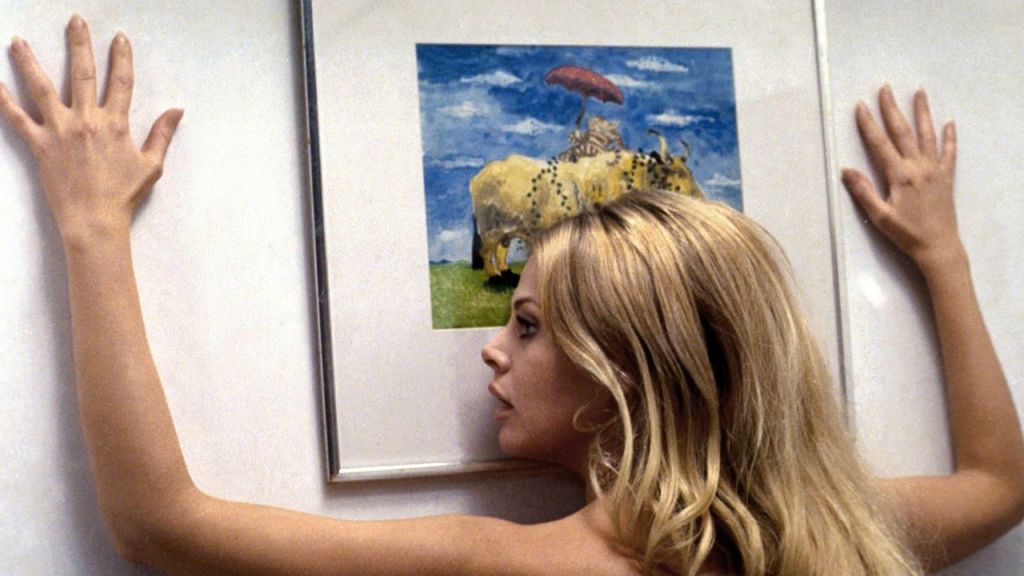
The following morning, Sergeant Howie is, of course, back on the case. His quest to find Rowan Morrison leads him to the school, where he is faced with preparations for the upcoming May Day celebrations. Outside the school, the boys are practicing their dance around the maypole (more music: the amusingly, if harmlessly, lewd “Maypole Song”). Inside, the girls are learning about the phallic imagery of the maypole. Horrified by what the children are learning, Sergeant Howie interrupts the lesson, berates the schoolmistress, Miss Rose (Diane Cilento), and learns that Rowan had, in fact been a student at the school. According to Miss Rose, Rowan has returned naturally to nature — or, to fit the Sergeant’s Christian worldview, died.
Sergeant Howie finds Rowan’s grave, marked by a tree hung with her umbilical chord, but cannot get a satisfactory answer as to her cause of death. He goes to the records office, and is told by the librarian (played by the wonderful Ingrid Pitt) that he has no right to any records without the express permission of Lord Summerisle. And, in either event, there seems to be no valid death certificate for Rowan.
From here, the obvious recourse is to visit Lord Summerisle and demand answers. Sergeant Howie meets with Lord Summerisle (Christopher Lee) in a very British manor house, while outside nude young women practice leaping over the fire for the May Day festival (surprise: more music). This juxtaposition sets up Sergeant Howie’s lack of balance for the rest of his conversation with Lord Summerisle — who is a wonderful mix of affable charm and matter-of-fact idiosyncrasy, made possible only by Christopher Lee’s performance. Lord Summerisle explains that the ways of the island are not those of the Christian mainland, and that they are perfectly happy for it.
When Sergeant Howie demands: “And what of the True God? Whose glory, churches and monasteries have been built on these islands for generations past? Now sir, what of him?”
Lord Summerisle calmly replies: “Oh, he’s dead. He can’t complain. He had his chance and, in modern parlance, blew it.”5
Lord Summerisle goes on to explain that his grandfather, a Victorian agronomist, bought the island in the late nineteenth century for its good climate and soil, and established the religion as practiced by the villagers:
“What attracted my grandfather to the island, apart from the profuse source of wiry labor that it promised, was the unique combination of volcanic soil and the warm gulf stream that surrounded it. You see, his experiments had led him to believe that it was possible to induce here the successful growth of certain new strains of fruit that he had developed. So, with typical mid-Victorian zeal, he set to work. The best way of accomplishing this, so it seemed to him, was to rouse the people from their apathy by giving them back their joyous old gods, and it is as a result of this worship the barren island would burgeon and bring forth fruit in great abundance. What he did, of course, was to develop new cultivars of hardy fruits suited to local conditions. But, of course, to begin with, they worked for him because he fed them and clothed them. But then later, when the trees starting fruiting, it became a very different matter, and the ministers fled the island, never to return. What my grandfather had started out of expediency, my father continued out of love. He brought me up the same way, to reverence the music and the drama and the rituals of the old gods. To love nature and to fear it. And to rely on it and to appease it where necessary. He brought me up…”
Sergeant Howie : He brought you up to be a Pagan!
Lord Summerisle : A heathen, conceivably, but not, I hope, an unenlightened one.
Despite his pearl-clutching fury at the practices of the island, Sergeant Howie does get Lord Summerisle’s permission to exhume Rowan’s body. What he finds in the coffin, however, is not the body of a girl, but that of a hare.
From here (after one more odd, bawdy, musical interlude involving Lord Summerisle and Miss Rose), the pace of the movie gains speed. More convinced than ever of an island-wide conspiracy to hide the truth, Sergeant Howie discovers the previous year’s May Day harvest photo — it shows Rowan Morrison as Queen of the May, and almost no crops. He becomes convinced that she is being hidden away for use as a sacrifice at the new celebration. When his attempt to leave the island for backup is stymied by his seaplane refusing to start, Sergeant Howie instead decides to research May Day rituals in the local libraries. He then conducts an oddly humorous door-to-door search for Rowan, bursting into people’s homes and going through every room and cabinet. At last, he decides to replace the innkeeper in the costume of Punch for the mummer’s parade, and hope that the ritual itself will lead him to Rowan. And, from here to the end, the movie is absolutely perfect.
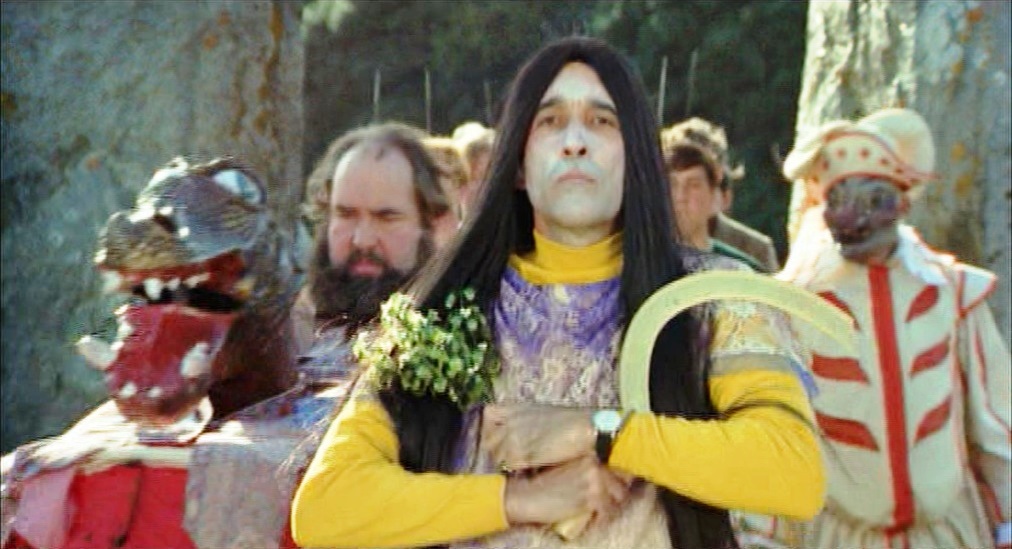
The procession itself is a carnivalesque mixture of silliness and tension, culminating in a sword dance where each villager must give stop within the ring of swords. The villager who is there at the wrong time is “executed” by the swords cutting off the head of their mask. At last, Rowan is revealed — dressed in white, with her arms bound. Sergeant Howie rushes to rescue her, and she leads him through the caves, up to the cliffs above. However, this is not to freedom.
Rowan, it is revealed, was actually part of the conspiracy — to bring Sergeant Howie himself as the sacrifice. Their crops did indeed fail the previous year, and the gods are due a sacrifice. “Animals are fine,” Lord Summerisle explains, “but their acceptability is limited. A little child is even better, but not nearly as effective as the right kind of adult.” And Sergeant Howie is exactly that adult. As the the three leading women of the village explain, this is:
“A man who would come here of his own free will. A man who has come here with the power of a king by representing the law. A man who would come here as a virgin. A man who has come here as a fool!”
Against his protestations, Sergeant Howie is prepared for the ritual, dressed in white and anointed with oil. He argues that the act of sacrificing another human being is monstrous, heathen idolatry; that he believes in “the life eternal, as promised to us by our Lord, Jesus Christ.”
“That is good,” Lord Summerisle assures him: “For believing what you do, we confer upon you a rare gift, these days – a martyr’s death.”
Sergeant Howie promises that this will do no good — whether they sacrifice him or not, the crops will still fail. And, next year, it will be Lord Summerisle himself who is sacrificed. He is dragged to the wicker man, already brimming with animals caged in its varying limbs, to be killed alongside him. As he cries out and prays to god, Sergeant Howie is locked inside, and the wicker man set alight. His singing of a psalm is gradually drowned out by the fire, and by the villagers gleefully singing “The Sumer is Icumen In” along the cliffs edge. At last, the fire consumes the wicker man entirely, and it collapses, revealing the setting sun over the water.
It is an unsettling and amazing ending, for a very inconsistent film.
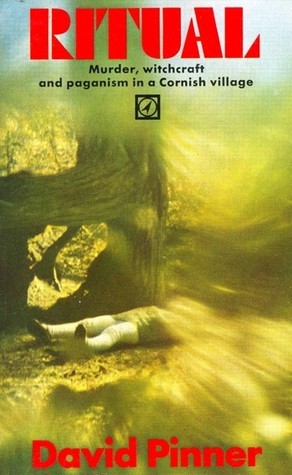
The movie was very loosely based on a 1967 novel by David Pinner, called Ritual. While some of the basics are the same — a policeman goes to investigate the death of a child in a remote, rural community and gets obsessed with the idea of occult and sexual practices underlying what’s wrong there — it does actually differ a great deal. The biggest difference, in fact, is that there is no conspiracy of any sort in Ritual. Rather, the policeman himself is responsible for the murders, and the majority of the novel is his descent into further madness.6 The (deeply unpleasant) villagers are actually pagans, but orgies seem to be the extent of their depravity.
So what accounts for the outsized place that The Wicker Man holds in the pantheon of both British horror and folk horror? It was hardly the first fictional foray into the world of strange, pagan cults and rituals. Indeed, as the social and countercultural movements of the sixties and seventies took root, and the responding moral panic shook the Mary Whitehouses7 of the world, media was rife with just such offerings.
Part of its lasting impression may well be the ambivalence of the messaging within the film itself, which appeals in many ways to both sides of the culture war. Robin Hardy, who directed the film, and his co-author, Anthony Shaffer, saw the potential for danger and fascism within countercultural movements. In a 1977 interview with Cinefantastique, Hardy said:
“For one thing, [active paganism] keeps people in the thrall of superstition. Maybe it’s not too big a connection to make between the final scene of THE WICKER MAN and the Nuremberg Rallies in Germany. It was no accident that Hitler brought back all those pagan feasts in his rise to power. It’s a great, German thing, really, Wagner after all was always going into the Niebelungen and Ring cycles, glorifying all the old German gods. The idea that it is necessary to sacrifice people for the good of other people is never too far from the human consciousness at any one time. You can’t simply say that it was something those people did all those years ago and has nothing to do with us today.”8
He also readily likened the actions of the people in Summerisle to the horror of Jonestown, and the sort of people (like Lord Summerisle or Jim Jones) who would force their communities to commit horrors for an ostensible great good, under the guise of religion. The entire town being involved in a dreadful conspiracy to lure the Christian policeman — symbol of two distinct forms of cultural acceptable order — to his death to suit their own ends clearly marks them as the villains of the story. It appealed to a certain type of Christian, even with all the sex and paganism. In fact, it found a receptive audience in the United States:
“Intriguingly, those ‘primitive sex rituals’ went down well in the Bible Belt, says Hardy. “We went to Bible breakfasts, showed the film, and there was much discussion. Funnily enough, they weren’t put off by the Britt dance or anything. But the religious side of it, the Christians just loved. They said it was one of the only films they’d ever seen that really explains what resurrection is about.”9
Despite this, the people of Summerisle are much more appealing than Sergeant Howie, particularly the charming Lord Summerisle himself. This could, perhaps, be meant as commentary on the seductive nature of cults. That interpretation is somewhat undermined by how deeply unlikeable Sergeant Howie is. With the callousness of horror audiences, many of us (myself included) are not terribly upset to see him sacrificed in the end.10 But, does he have to be likeable? Here is a man who thinks that a child’s life is at stake — and perhaps the lives of other children. In many films, his refusal to be put off of that mission would be lauded. And yet, I don’t think I have ever heard someone who sides with Sergeant Howie.11 They either view it as a clash of two equally unsympathetic cultures, or they side with the pagans.
Which brings us to the other side of the coin in the film’s reception: how much it has been embraced and mimicked for subsequent depictions of paganism, in and out of cinema.
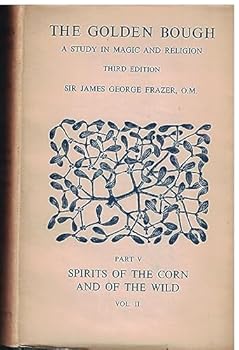
Hardy and Shaffer always made a great deal of the research they did to underpin the creation of The Wicker Man — and the bulk of that research came from James George Frazer’s The Golden Bough: A Study in Comparative Religion. Much of The Golden Bough has since been widely discredited as having any basis in pre-Christian traditions. I am sorry to disappoint people, but there are no pagan traditions stretching unbroken between here and antiquity, however much we love that trope showing up in fiction. The majority of modern British and American pagan practices have their roots in the nineteenth and twentieth centuries, drawing from Aleister Crowley and the Hermetic Order of the Golden Dawn (1880s), from Madame Blavatsky and the Theosophical society (1870s), the ley lines of Alfred Watkins’ The Old Straight Track (1925), The White Goddess by Robert Graves (1948), and, yes, The Golden Bough (1890). While these things do reference older traditions, they also picked and chose and reshaped (or made up) ideas to fit their own image of what it should look like, allowing for the cobbling together of what Ronald Hutton calls a “romantic truth” of pagan religion.12 The seeming consistency between them comes from crosspollination. Both Aleister Crowley and Robert Graves cited Frazer as strong influences on their work, as did Gerald Gardner, who shaped modern Wicca. As Liz Williams wrote in the introduction to her Miracles of Our Own Making: A History of Paganism: “if you are to trace modern paganism back, the majority of its significant paths can be shown to have deep roots in The Golden Bough.“13
However, while many people have said that this undermines the research that went into The Wicker Man, I think it rather enhances it. After all, it is exactly what Lord Summerisle and his family have done on Summerisle. They have picked and chosen and created a new set of practices that are legitimized by their seeming antiquity. Even the wicker man itself, though it was reported by Julius Caesar in his Commentary on the Gallic War, is generally perceived to have been Roman propaganda against their enemies. There are some small evidences of human sacrifice having been practiced in early Britain, but nothing on the scale of the wicker man. Its reality does not matter, either to the religion of Summerisle or to the audience of a horror movie. It is the idea that makes an impact.
In the documentary Woodlands Dark and Days Bewitched14, folklorist and cultural historian Nina-Gail Anderson says: “Of course, the difficulty is that there’s no bible of what these customs were. So, often you’re connecting it with revived or reinvented customs via modern witchcraft and people like Doreen Valiente, who was – you know – the doyenne of what we think of as ‘traditional things’. Well, they have their roots in tradition, but they were invented. But movies will always need to go for what looks good on screen. They may well play their own game. And sometimes it’s frustrating for a folklorist because what it says in the movie becomes the folklore.” This ties very naturally back to Ronald Hutton’s romantic truth: there is something about the way we see these pagan practices being portrayed that feels true, and so it gets folded into the wider culture, both in subsequent films and in actual practice.
It likely helps that many of the images and actions that we see on screen in The Wicker Man do, in fact, come from long standing folk traditions in Britain. Things like the Mummers Parade and Morris Dancing are visible parts of rural life in England that can be either pastoral or off-putting depending on the slant of the presentation.15 And that familiarity lends credence to what the audience of the movie is being shown.
In “The Wicker Man, May Day, and the Reinvention of Beltane,”16 Richard Sermon traces the interesting array of influences that come together to shape the pagan practice we see in The Wicker Man, ranging from Gaelic and Welsh writings (the names of Summerisle’s gods) to the writings of Robert Burns (many of the songs); the sword dances of Yorkshire, Durham, and Northumberland to the 19th century Harvest festivals, in a way that illustrates how it incorporates existing traditions into something that feels honestly historic and rooted to the land. Additionally, he discusses how the movie uses The Golden Bough‘s attempt to recreate a Celtic calendar to merge Beltane, May Day, and fire festivals into a single idea that has since taken on a life of its own, adding:
“While the film was itself influenced by contemporary thinking on paganism and folklore in the 1970s,
the film’s imagery has since become the inspiration for many new celebrations. These include the Burning Man Festival in Nevada (since 1986), the Beltane Fire Festival in Edinburgh (since 1988), and the Wickerman Festival in Kirkcudbrightshire (since 2002), along with host of Neo-Pagan rites that can be found on the Internet. … Interestingly, the film also appears to have inspired modern re-enactments at a number reconstructed Iron Age settlements, where public events have included the burning of a wicker man. At the Peat Moor Centre near Glastonbury in Somerset a wicker man is constructed every Samain (end of October) and burnt at dusk, while at Gillingham in Kent the Iron Age re-enactment group the ‘Cantiaci’ do the same at Beltane (beginning of May). At Castell Henllys in Pembrokeshire an Iron Age hillfort fort has been archaeologically excavated and almost completely reconstructed. The site is run by the Pembrokeshire National Park and was used by the BBC for their living history programme ‘Surviving the Iron Age’ in 2000. This was a reality programme with a difference, where members of the public volunteered to live (if possible) as Iron Age people. To celebrate the end of their stay the volunteers constructed a wicker man, which they burnt at Samain. Since then Castell Henllyss has hosted a number of wicker man burnings on Imbolc (beginning of February), Beltane, and Samain.“
Again, what we’ve seen becomes the folk tradition. And, by telling ourselves that it is an unbroken line of folk tradition, it lends the actions a feeling of subversive legitimacy that appeals to a very human impulse. We like the idea of sharing forbidden knowledge, we like the idea that something has come through despite the odds. The fact of those newly created traditions, however, benefits from the fact of its newness — it can reshape itself to what appeals in the moment. And The Wicker Man built the gateway to linking old and new in a generation already primed to look for it.
Additionally, The Wicker Man offers an interesting — if bleak — dialogue on the clash between the old and the new, and the way that both can be quite dangerous in different ways, played out in the opposing figures of Sergeant Howie and Lord Summerisle. To once again quote Howard David Ingham: “Folk horror is rarely presented this way. In pretty much every other example (except maybe Blood on Satan’s Claw, now I come to think of it), you have progressive city folk or figures of authority facing off against conservative country folk following the old ways. In The Wicker Man, however, the religion is a Gardneresque neopaganism, and the real old religion is Sergeant Howie’s Christian faith. The flipping of old and new makes The Wicker Man fresh, compelling even after forty or more years. And it allows for an identification with modern pagans that the old religions of film and tv do not otherwise often have. In most folk horror there is the warning that we don’t go back. But in The Wicker Man, the subtext is just as much that we don’t go forward.”17
From Anthony Schaffer himself: “Paganism has a habit of surviving, as we see. And it’s that which helped this film survive: the subject matter.”18
And, likewise, The Wicker Man is a movie that survives. We keep circling back to it, and bringing it back. There are at least three different versions of the film in existence: the 1973 theatrical release, and “Director’s” and “Final” cuts released in 2001 and 2013, respectively. In 2023, for the fiftieth anniversary, all of the versions were remastered and released on blue-ray. In 1978, Hardy and Shaffer wrote a novel based on the novel. In the eighties, Shaffer wrote a treatment for a sequel; in 2011, Hardy made The Wicker Tree, which is a strange companion film to The Wicker Man. There was a deeply ill-advised remake from 2006, starring Nicholas Cage, and featuring some of the most laughably awful scenes in a high-budget horror film. And like everyone who came before me, I have the hubristic idea that I could figure out how to edit the original into the movie I want it to be. Or, remake it entirely in a way that works.19 There is something about The Wicker Man that brings that out in people who love the genre. We don’t want to let it go, and that is its own special magic.
- This summary, and the interpretation that follows, are based on the theatrical version of the film, not later edits/releases. ↩︎
- The lyrics come from Robert Burns, the music was written for the film by Paul Giovanni. ↩︎
- I do love the not-so-subtle way that the majority of the denizens of Summerisle are named for plants, and particularly trees with a great deal of folklore attached to them. ↩︎
- We Don’t Go Back: A Watchers Guide to Folk Horror, Howard David Ingham ↩︎
- Lord Summerisle really has some great lines in this scene. Another favourite: “Do sit down, Sergeant. Shocks are so much better absorbed with the knees bent.” ↩︎
- There is, of course, a lot more to the plot of the book than I have included here. It is a rambling, muddled mess that the author thought included a fair amount of nuance and humor, but mostly it just feels pulpy. If you want to track down a copy and read it, I will leave judgement up to you. But fair warning: it is very 1967. ↩︎
- Mary Whitehouse was an English conservative activist, whose crusade against “filth” in British media still has repercussions to this day. The year before The Wicker Man was released (1972), she launched her Nationwide Petition for Public Decency, which garnered a million signatures by early 1973. ↩︎
- “The Wicker Man,” David Bartholemew, Cinefantastique — full article can be read here ↩︎
- Long arm of the lore: Robin Hardy on The Wicker Man, Vic Pratt, BFI ↩︎
- Even my mother has echoed this sentiment. Her synopsis of this movie is: “Nasty cop goes to cute little village and gets killed.” Just saying. ↩︎
- Except for Howard David Ingham, in his chapter on The Wicker Man in the above mentioned book We Don’t Go Back, which is very worth reading. He makes an impassioned defense of the Sergeant, and discusses child sexual abuse in Summerisle; but it is much more based on the 2001 version of the film than the original theatrical release. ↩︎
- The Triumph of the Moon: A History of Modern Pagan Witchcraft, Ronald Hutton ↩︎
- Miracles of Our Own Making, Liz Williams ↩︎
- Woodlands Dark and Days Bewitched: A History of Folk Horror, directed by Kier-La Janisse ↩︎
- Personally, I always think mummers are creepy. ↩︎
- “The Wicker Man, May Day and the Reinvention of Beltane”, Richard Sermon, The Quest for the Wicker Man ↩︎
- We Don’t Go Back: A Watchers Guide to Folk Horror, Howard David Ingham ↩︎
- Woodlands Dark and Days Bewitched: A History of Folk Horror, directed by Kier-La Janisse ↩︎
- I am always torn between the idea that it still needs to be in Scotland, and the idea that it would work really well in modern day Maine. Which might be due to the fact that I live in Maine. Either way, it would lose a certain something in the absence of Christopher Lee. ↩︎
 the shadowes are icumen in