Hello, friends, and welcome to the inaugural post of our Historical Curiosities column! History is full of the weird, the spooky, and the confounding. In this column we’ll share fun anecdotes that fit the bill. So, join me as we kick things off with one of my favourite strange tales — the werewolves of Ossory.
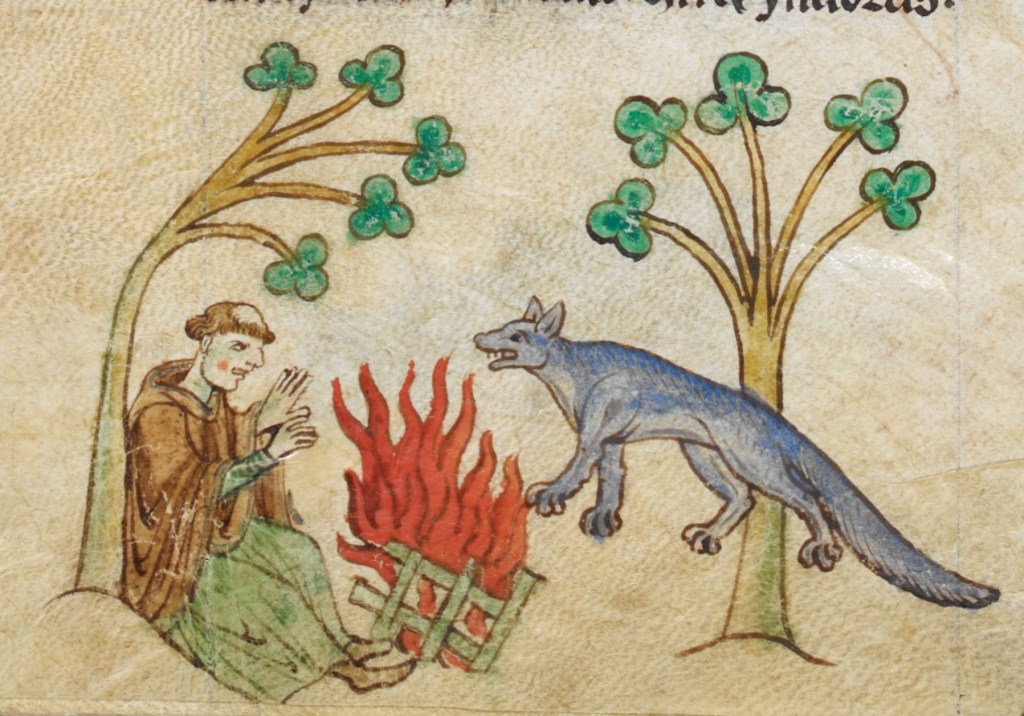
In the late twelfth century, a priest was travelling from Ulster to Meath, in Ireland. The journey being long, he and the boy who traveled with him were forced to camp for the night in the woods on the outskirts of Meath. As they sat by the fire, they were startled by a wolf entering the camp and sitting by their fire. To their further astonishment (and, one would imagine, fear), the wolf addressed them in human speech, telling them that there was no reason to be afraid. In an attempt to set them at ease, the wolf concluded by quoting scripture, and answering questions of the Catholic catechism, as it was believed that demonic things could not pray.
The priest demanded to know what sort of creature the wolf was, and what he wanted with them. The wolf explained that he was originally a man from the nearby diocese of Ossory. As the result of a curse placed on the people of Ossory by a saint or bishop, every seven years a man and a woman would be forced to take the form of wolves, leave the settlement, and live in the forest. At the end of those seven years, assuming both had survived the trial, they would return home and a new pair would take their place. Only now, the woman who was his companion in the curse was deathly ill, and the wolf wanted the priest to offer her the consolation of last rites.2
Hearing this, the priest allowed the wolf to lead him a short distance into the woods, where he discovered a large hollowed tree containing another wolf, who groaned in a human voice. On seeing the priest, she offered thanks to both him and God for offering her the comfort of the church in her illness. He proceeded to duly perform the last rites, but balked at the moment of offering the final communion. She begged him to complete the rite, but the priest refused, claiming that he had no communion wafers to give.
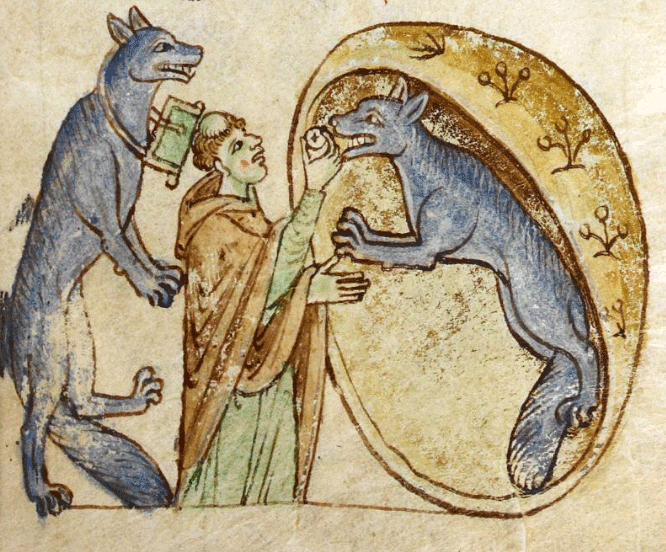
At this, the original wolf (who had respectfully moved a short distance away, to give them privacy), came back over to point out that of course the priest carried consecrated wafers. It was the practice of the time and place for priests to carry them in a small missal book worn about their necks while they traveled, and the male wolf pointed out that he had seen just such a missal hanging beneath the priest’s cloak. When the priest continued to refuse — perceiving the action of giving communion to an animal as sacrilegious — the wolf removed his companion’s wolfskin, revealing her to be an elderly woman.
Shaken and afraid, the priest agreed to give her communion as she had asked, and completed the office of last rites — which the female wolf devoutly received. This done, her companion tucked the wolfskin around her once more, and she returned to the form of a wolf.
She stays in her wolf-form in the illustration
The first wolf then escorted the priest back to his campsite, and watched over him and his companion until the morning. Then he led them back out of the woods, and pointed out the best road to take towards Meath.
This story comes to us from the Topographia Hibernica (Topography of Ireland), written in 1188 by Giraldus Cambrensis, or Gerald of Wales. Gerald of Wales (c. 1146 – c. 1223) was an archdeacon and historian best remembered for his time serving King Henry II of England. The Topograohia was written for the King while Gerald accompanied Prince John on his visit to Ireland. It is a strange book — as the title suggests, it includes a description of the topography of Ireland, but also descriptions of animals, miracles, strange happenings, history, and even sections inexplicably about Norway and Iceland. Gerald does not hide his less-than-complimentary view of the Irish people, which sometimes makes this book more useful in illustrating the Norman view of Ireland than a true account of the place itself, but it is certainly interesting.
His recording of the above incident is in a chapter with the marvelous title: “Of the prodigies of our times, and first of a wolf which conversed with a priest.” While he says the events themselves occurred several years before he came to Ireland, he describes his knowledge of the matter like this:
It chanced, about two years afterwards, at the time when the bishop of that land had convoked a synod,3 having also invited the assistance of the neighboring bishops and abbots, in order to have their joint councils on what was to be done in the affair which had come to his knowledge by the priest’s confession.4 The bishop, hearing that I was passing through those parts, sent me a message by two of his clerks, requesting me, if possible, to be personally present when a matter of so much importance was under consideration; but if I could not attend, he begged me at least to signify my opinion in writing. The clerks detailed to me all the circumstances, which indeed I had heard before from other persons; and, as I was prevented by urgent business from being present at the synod, I made up for my absence by giving them the benefit of my advice in a letter. The bishop and synod, yielding to it, ordered the priest to appear before the pope with letters from them, setting forth what had occurred, with the priest’s confession, to which instrument the bishops and abbots who were present at the synod affixed their seals.5
Obviously, there is no way of verifying a second or third hand tale from the twelfth century. There is actually quite a bit against it. As John Carey points out in the article “Werewolves in Medieval Ireland,”6 there is nothing that indicates such a synod was held in Meath, or that any such account ever made it to the Vatican. He argues that both were made up to bolster the truth of the tale. And it is hard to ignore how much this anecdote points out how very important and respected Gerald himself was. That said, I love this story — and how both strange and matter-of-fact the reporting of it is. And, there is another tale that talks about the wolves of Ossory, and how their curse may have come about.
In the Konungs skuggsjá (or “King’s Mirror,” a 13th century Norwegian manuscript written to be part of the education of King Magnus Lagabøte, and presented as a series of dialogues between a father and son about law, morality, and ruling)7 there is an account of Saint Patrick traveling to Ireland and converting the pagans there to Christianity. When he reached the region of Ossory, he encountered a tribe of people who entirely rejected him and his teaching. To mock Saint Patrick, they would howl like wolves over the sound of his preaching. Furious at his treatment, Saint Patrick prayed to God for them to be punished, and the tribe and their descendants were cursed to be werewolves.
One way or another, it is a remarkable story.
I love that the illustration in the Topographia shows the priest looking more annoyed than afraid. ↩︎
It’s interesting the way stories change over time, and away from their source material. When I was first introduced to this story, the two wolves were man and wife. They seemed to be the only ones under a curse, and every seven years they had a brief period of being humans before returning to their wolf form. Both versions are terribly sad, but this version feels a little more Ladyhawke than the original. ↩︎
For those of you lucky enough to have not been raised Catholic… a synod is a council of church delegates meeting to discuss ecclesiastical law ↩︎
 the shadowes are icumen in