The television flickers to life. Scenes unfold before you, complete with lonely castles, stalwart heroes, buxom women, and, of course, luridly red blood splattered across a stone tomb — in Technicolor! This is the stuff on which thousands of late-night horror viewings have been built. And tonight’s movie is the ultimate classic of the genre. On to the sophomore entry in our Terrible Vampire Movies column — Terence Fisher’s Horror of Dracula!
Now, to be perfectly fair, I do not consider Horror of Dracula to be a terrible movie. In fact, if it counts as a terrible vampire movie, I am going to say that there has never been a good vampire movie.1 But, it still gets a place in this column for its borderline camp, and for being the origin point of the majority of the imagery that we associate with those films. It is a mock-Gothic marvel, and, if you haven’t seen it yet, you are in for a real treat.
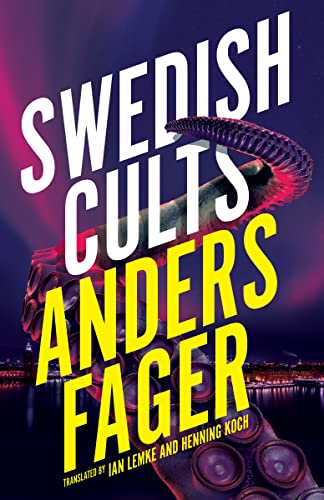
Anders Fager’s creeping, ichor-sticky collection, Swedish Cults, begins with a story about, well… a cult. But it’s the kind of cult action I absolutely love, in which there is no great fanfare about all this ritual business, and the cult itself sits almost comfortably in plain sight, a set of practices and traditions that everyone in a community more or less acknowledges as having always been there. “The Furies of Boras” sees a modern set of teenage girls out at a dancehall, at a place where there has always been dancing, and as perennial as teenage girl politics and concerns, as perennial as the dancing, is the thing in the bog waiting for its due.
“Anna closes her eyes, sees primeval swamps behind her eyelids. Swamps and rain and kisses. The Pussycat Dolls’ ‘Don’t Cha’ blares through the speakers. Sofie scans the place. She’s thinking about her history project. There’s a lot going on in your head your final year. Industrialism in the Vastergotland region and bogs and kisses. … Stares at the girls and stares at a telephone pole of a tentacle less than a meter from her forehead. A twitch and she’s dead. Not much fun. And on top of everything she has an essay to hand in.”
All of Fager’s stories have this matter-of-factness, a sense of brains skipping a beat when forced up against the incomprehensible, sliding over hysteria and protest directly into a kind of shock of acceptance. There is something indelibly human about a high schooler in a cannibalistic orgy, watching the lumbering, eldritch swamp-beast she and her cohorts are petitioning, worrying about a history essay she has to write. Such a detail might seem farcical in the hands of a less-keen observer, but Fager knows how to fit the mundane against the outlandish pretty seamlessly.1 His Lovecraftian horrors are glimpsed rather than belabored, appearing obliquely in conversations between two old friends, in the subtle changes in a boyfriend returning from abroad, in a name uttered into the winter air. In his precisely-drawn characters, appearing as sharp as miniatures in the brief space they occupy, we feel lives proceeding mostly normally until, inexorably, they slip into the uncanny; as with Laird Barron’s horror fiction, much of the impact of Fager’s work lies in this dread as things slip away from the familiar with no hope of getting back to the right path.
Valancourt Press, which published this for American audiences, has been doing a lot for weird fiction both vintage and contemporary; their republishing of many of the luridly great titles featured in Grady Hendrix’s delightful Paperbacks from Hell is a tremendous service to an all-too-ephemeral age of horror fiction. I’m really looking forward to checking out many more of their offerings based on the strength of this title alone.
Definitely to be credited here, too, are his very capable translators, Ian Lemke and Henning Koch. ↩︎
This is a review literally years in the making. I first listened to the audiobook1 back in, I believe, 2020 when it first came out, and I am not sure I can adequately convey how enthralled I was. I listened to it at home — alone in the kitchen, making tea, or outside shoveling snow off the front walk. I listened at work, alone in the otherwise darkened bookstore before we opened, or in the back office while I stared at spreadsheets and inventory numbers. When I was out front, doing the customer service parts of my job that could not be done while wearing headphone, I resented having to tear myself away. And, when it was finally over — in all its hair-raising, satisfying glory — I felt slightly at a loss for how to fill the silence. I missed the characters and the place and the cadence of the actors’ voices. So I started it again. I am, admittedly, the sort of reader who can truly fixate on stories that appeal to me, and this novel brought it out in all the best ways.
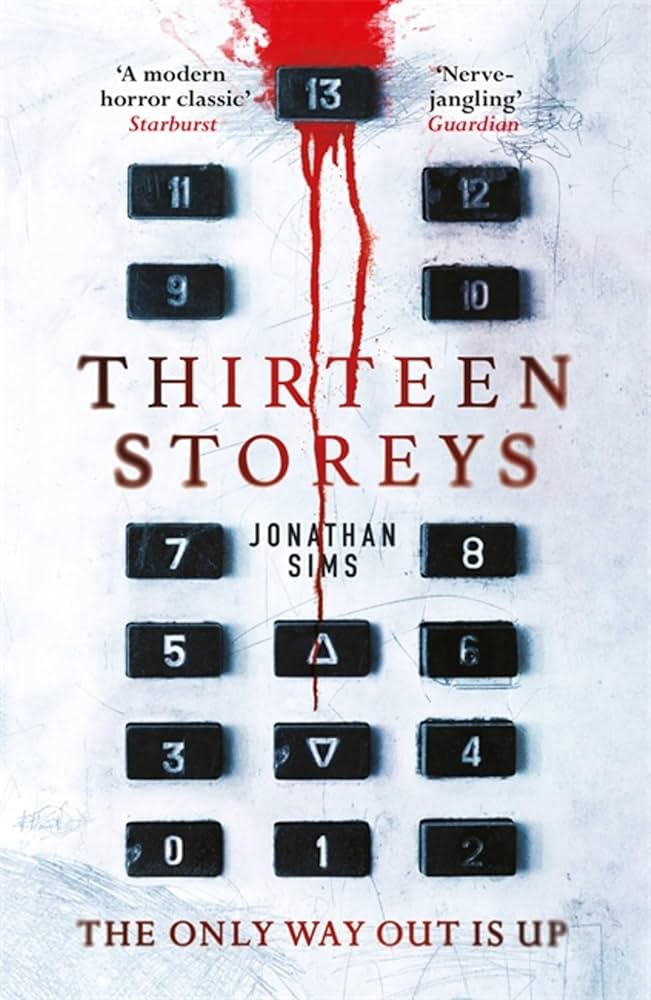
The conceit of Thirteen Storeys is more or less a simple one: an infamous, reclusive billionaire died under mysterious circumstances at a dinner party in his penthouse at a luxury tower block, and none of the thirteen guests — a random assortment of people related to the building, including a small child — were ever arrested for the murder. The novel then offers a series of interconnected horror stories about the guests and the building, culminating in the event itself. This brief description in no way does justice to the brilliance of the book. As with anything, stripped down to its bare bones, it sounds plain and almost derivative. Nothing could be further from the truth.
Before we go any further, I should preface this review by pointing out that Thirteen Storeys comes with every non-sexual content warning you can possibly think of. That said, it is worth all of them. So, gird your loins, and let us proceed.
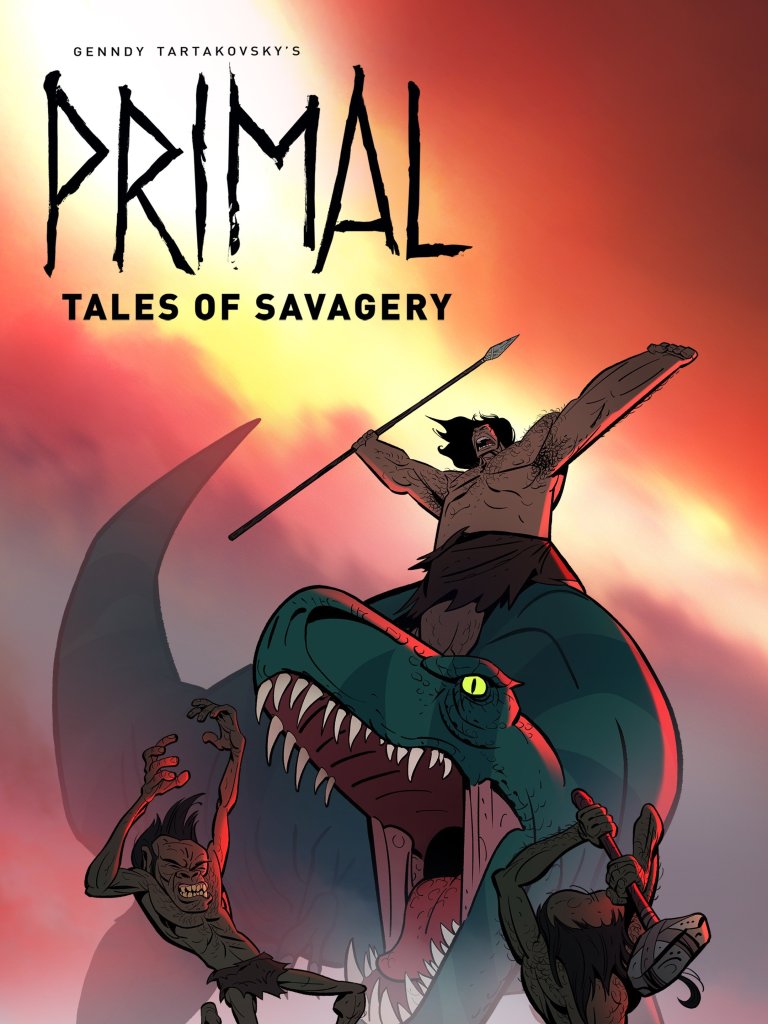
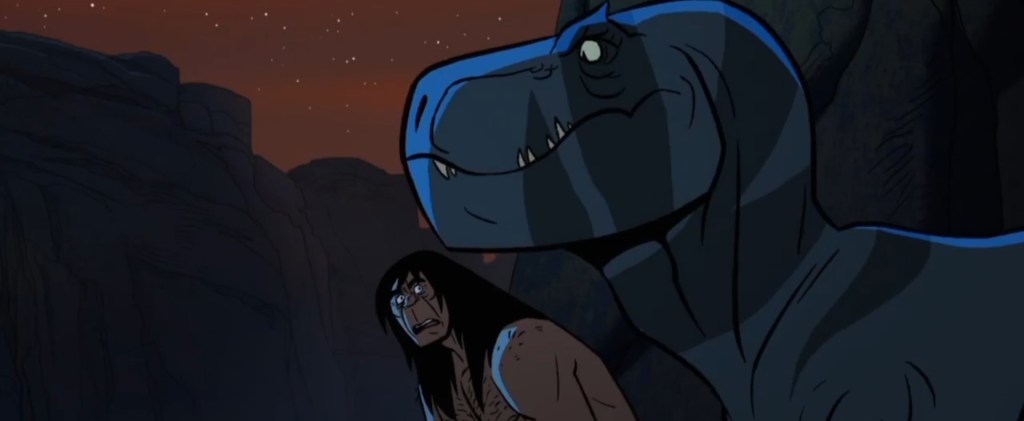
Genndy Tartakovsky’s Primal, his two-season epic animated series featuring the journeys of Spear, a Neanderthal, and Fang, a tyrannosaur, is an incredible achievement in world-building. It’s pulpy, imaginative, emotional, and tense, each episode a remarkably heady and rich tapestry of landscape and character, packing in way more depth than every 22-minute runtime seems able to contain. And the show builds this world with absolutely no words spoken. Tartakovsky’s work thrives on a minimum of dialogue (see Samurai Jack and The Clone Wars at their finest), but Primal eschews it altogether, orienting us toward the world as Spear and Fang see it, as a network of complex interactions between creatures trying to survive an unforgiving existence. Close observation is essential to their success in this world, and so we, too, are keenly attuned to the beings they encounter. We can’t rely on linguistic explanation for what we see, and so are locked into this highly intimate, emotive focus. A lesser filmmaker would stumble at the admittedly very tall order of getting audiences deeply attached to a caveman/t-rex duo, but Tartakovsky knows what he’s about.
This setting, filled as it is with prehistoric creatures and weird magic, allows for a lot of tension and spookiness, but nothing matches the sheer terror of “Plague of Madness,” an episode in the show’s first season. It encapsulates everything Primal does so well. It’s visually arresting, it communicates the inner lives of the protagonists and of the animals they meet so keenly, and it asks us to face a world before and beyond the explanatory crutch of metaphor. It also answers a question close to the hearts of many horror fans: how do you make zombies scary again?
Easy! Make the zombie a thirty-ton brachiosaurus1.
Oh no.
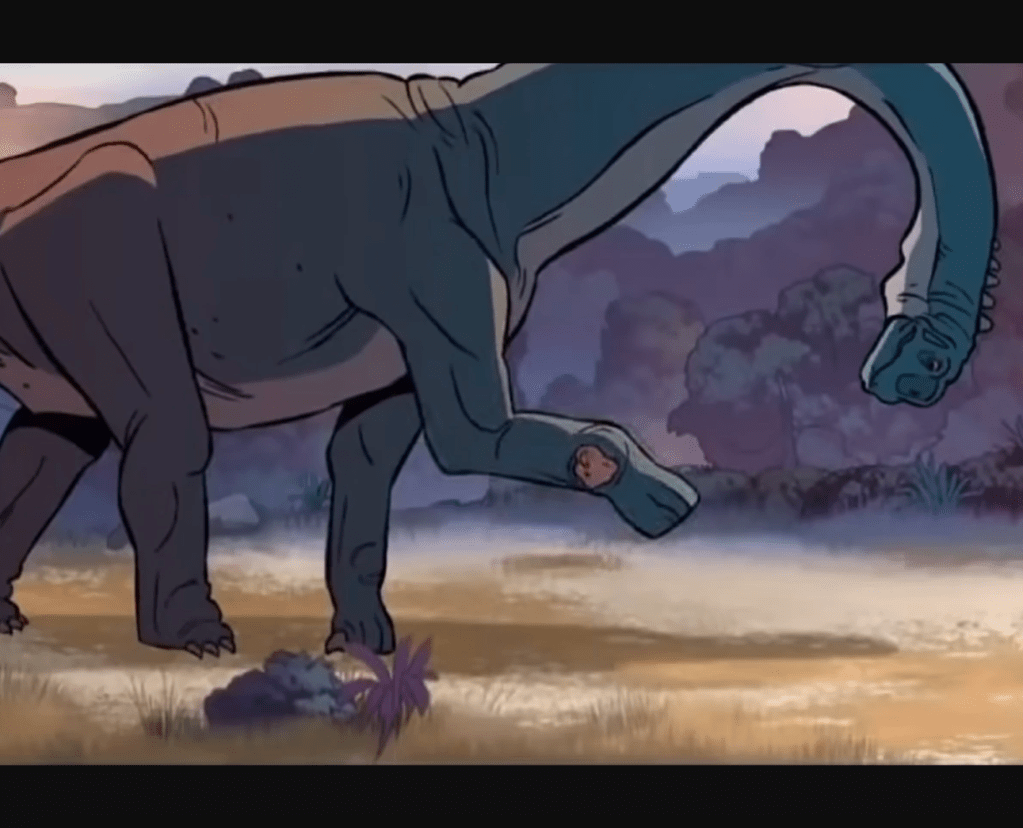
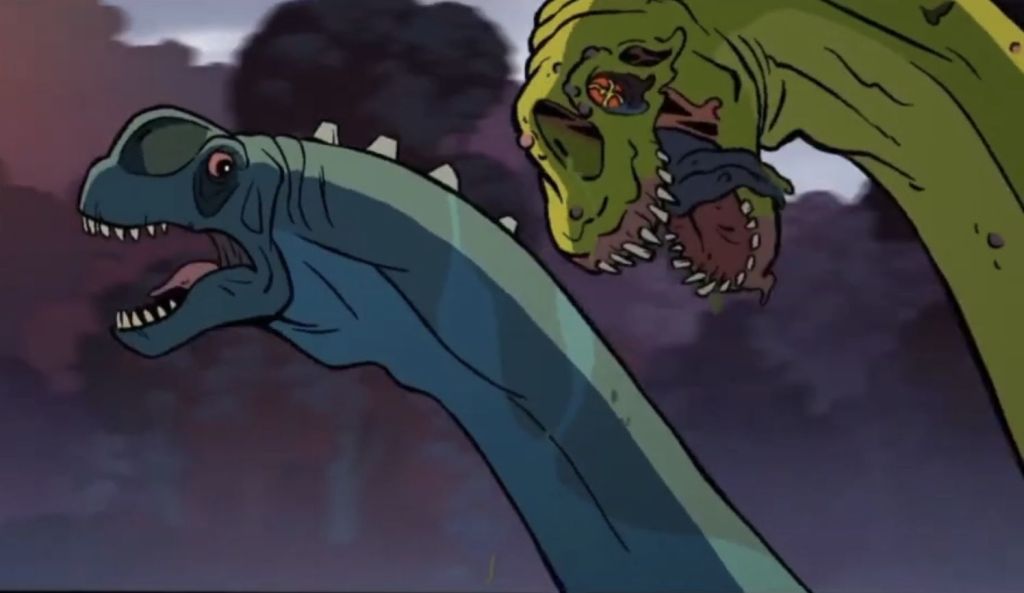
The episode begins with unusual tranquility for the show, with a herd of sauropods peacefully going about their business, grazing leaves, tending their eggs, chilling out in pools. Like all of Tartakovsky’s non-human characters, these creatures are imbued with great inner life, their expressions and body language imparting intelligence, dignity, and gentleness. The bucolic scene is punctuated by an incredibly small, comparatively, intruder- a spastic, mad-eyed, drooling parasaurolophus, staggering with rabid loopiness toward one of the brachiosaurs. A tiny bite from this tiny animal on the giant’s leg is enough to doom this whole scene to an insane hell, but as the brachiosaurus flicks the smaller dinosaur away into a tree, eyeing its death-spasms with cautious worry, it feels impossible that this towering creature could be ruined by this insignificant one. It compounds the sense of dread.
OH NO.
We’re not given much time to dread, however, as the infection takes over the brachiosaurs. We see it struggling toward water, clearly sick, and while we know, in a way, what’s coming, it’s tragically clear the animal doesn’t. It gulps down water in an attempt to alleviate a fever we know is completely unnatural, before violently vomiting blood and succumbing to the full madness of the plague. It’s damn gross, but worse is the now-mindless creature’s rampage against its herd, wherein it breaks backs, tramples eggs, bites and kicks its baffled compatriots into so much pulp. There’s no reason we can see for its sudden, explosive frenzy, but of course there is no reason.
Spear and Fang come across the aftermath of this bloodbath, and even the tyrannosaur is stricken by the carnage. Neither of the protagonists, for all their predatory acumen, would be able to tackle the brachiosaurs, and we see their unease as they wonder what animal is of a size to do so. One of their own, it turns out. Deprived of any other focus for its compulsive violence, the brachiosaurus fixates on the appropriately horrified Spear and Fang, launching an utterly terrifying chase through jungle and down sheer cliffs. The thing just. Won’t. Stop. It’s beyond living, beyond thought, reduced to this juggernaut of intractable hostility and rotting meat. It’s prehistoric Cujo.
My thoughts exactly, guys.
Heightening the tension of the episode is Spear’s understanding of how corrupted and unnatural this creature has become. He is frightened by it in a way we haven’t really seen in the character before, on a seemingly existential level; a nightmare in which he and Fang both succumb to the same affliction as the brachiosaurus, their flesh melting and their minds evaporating, reveals a deeper dread than Spear’s usual concerns about survival. Whatever has afflicted the sauropod is crueler and more utterly annihilating than death. The plague is self-erasing, completely negating what this animal once was, its innately pacific, dignified nature obliterated. At risk is his own inner life, his own keenly felt sense of what he is in the world he inhabits. This plague is worse than death. It’s annihilation.
It’s this intimate focus on individual erasure which makes the brachiosaurus such a satisfyingly scary monster. The deranged brachiosaurus is what we would recognize as a zombie- it’s dead but still ambulatory, it had a soul or an active intelligence which it has lost- but it’s a zombie which stands for nothing else. It serves no commentative purpose because its world matrix has no society to comment on. What’s left is a very distilled, very effective terror, and a very personal one. It also injects pathos back onto the zombie. We understand the mad brachiosaurus as an individual, its condition as upsetting and tragic as it is terrifying. It’s not really fair that this happened to it, and again the spirit of poor Cujo is present. Neither animal did anything to deserve their fates, and we wish they hadn’t suffered them, even as we also really wish they would please, please just die. Spear’s fear of this creature, like ours, is tempered by the same pity. He and Fang lead the beast into a lava field where it blunders into the magma and finally perishes, though not before being fully engulfed into fire and still trying to kill them. As he watches it flail and scream in rage, at last becoming nothing but so much ash, Spear is clearly stricken by the unfathomable, grotesque fate of this creature. There’s no triumph in its defeat, just horrible relief.
A rare instance of the zombie evoking pathos.
I love this show for a lot of reasons, but this one episode is such a stark statement on how horror can function separate from its tendency to be used as metaphor. The brachiosaurus stands for nothing- it is a void, truly Unnatural. By stripping away so many of the trappings of modernity, by focusing on the minute details of character in a rich but rarely human world, Tartakovsky reminds us that fear is far more base than our epistemic habits permit. It’s nothing but itself, hitting at the deep, wordless core of ourselves. Primal.
Technically, it’s an Argentinosaurus. Visually, the two species are very close, and I think brachiosaurs are more recognizable, so that’s the term I’ll be sticking with. It’s not scientific, but neither are zombie dinosaurs. ↩︎

 the shadowes are icumen in