Horror is an ouroboros. It remains an unresolved and unresolvable aspect of the form, whether horror in media becomes the originator of what frightens us, or if we are already frightened of something to which horror gives a name, a locus. Like science fiction, the best horror is both rooted in timeliness, responding to the specific cultural milieu in which it arises, and unbound by temporal limitations. Perhaps that’s part of what compels some of us about horror, its protean, slippery tendency to elude our ability to control it; perhaps that resistance to control is exactly what repels others.
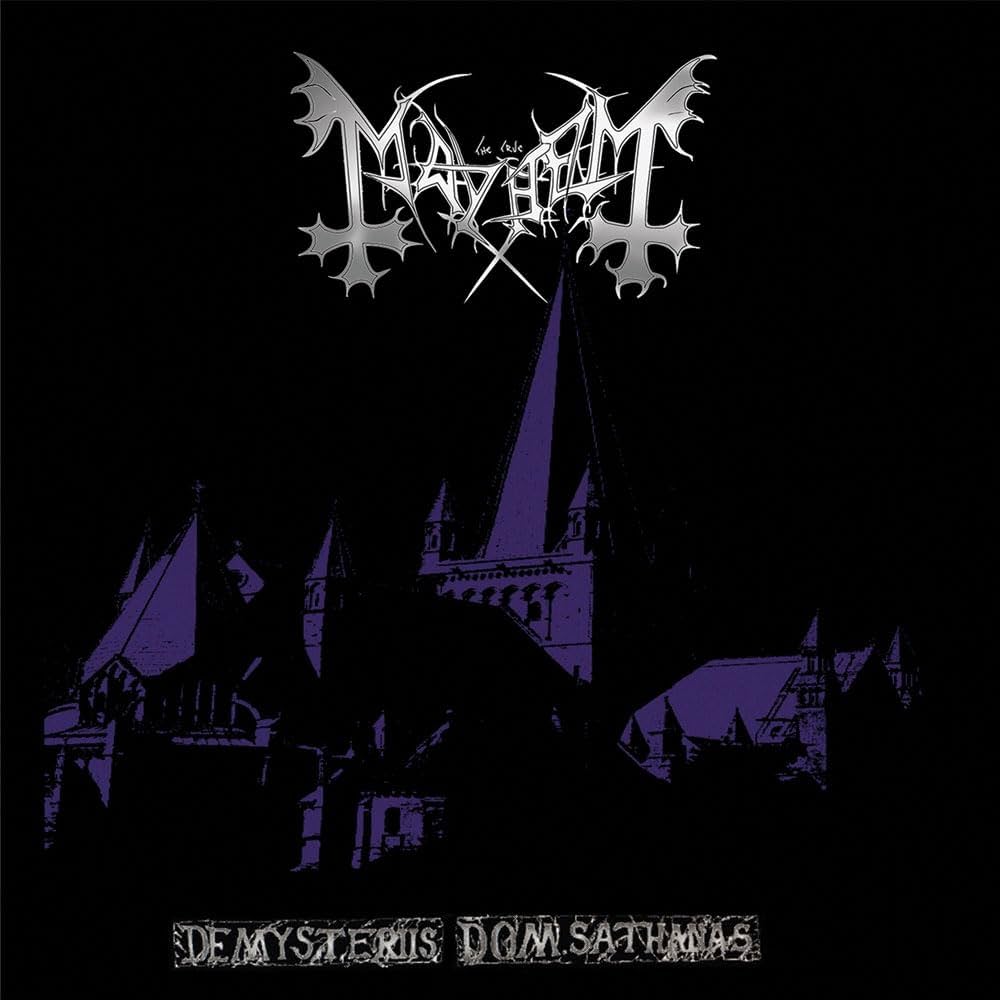
Thirty years ago, Norwegian black metal band Mayhem released, finally and half-posthumously, De Mysteriis Dom. Sathanas (DMDS, as it’s widely and mercifully abbreviated), and the album sits in that ambiguous territory so much great horror does, swallowing its own tail, the originating site of unease and a consequence of it. And, like many other great works of horror, its behind-the-scenes notoriety has further muddied the source of its impact. Would we find Poltergeist as spooky as we do if we didn’t know how much untimely death followed those involved in making it, if we didn’t know those bodies in the pool were real1? Similarly, would DMDS feel as unnerving if we didn’t know how much death preceded its release? The legendary, ugly shadow of violence can obscure the sheer unholy excellence of this album, its continued power to unsettle, and its complexity; the tabloid-frenzy luridness of the black metal scene in Scandinavia in the early 1990s can too easily become caricature, rendering DMDS a historical curiosity rather than an ongoing source of inspiration, relevance, and real horror.
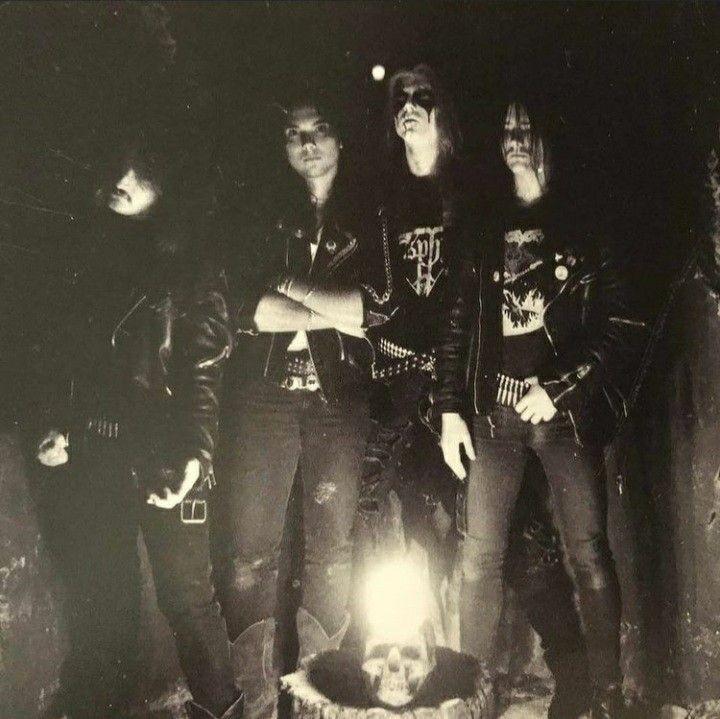
Mayhem looms over the subgenre of black metal as its ghoulish, unavoidable parent terrible; in many ways, it feels more like an institution or a cultural form, the platonic ideal of Black Metal, than a band which actually wrote, performed, and recorded music2, which did not spring fully formed from the head of Satan but evolved and changed as its members did so, as well. Even before the release of DMDS, however, Mayhem had a gift for self-mythologizing, embodied most ably in the person of chief architect and guitarist Oystein Aarseth, better known as Euronymous. His connections to the small, burgeoning black metal underground, and Mayhem’s position as foundational in that scene, guaranteed that its early audience already had a sense of what DMDS was like; they certainly knew what Mayhem was like as a live band, its stage routinely decorated with dismembered carcasses from butcher shops and its set punctuated by the very un-simulated self-harm of lead singer Pelle Ohlin (Dead, to use his black metal sobriquet). To add further murk to the question of where horror starts, then, we have this foregrounding of DMDS’s initial reception, this familiarity with a band which had released almost no studio material in 1994 and yet already was understood as a site of a very specific, misanthropic kind of ritualistic aggression, something darker and weirder than the death and thrash metal which thrived in the late 1980s and early 1990s. So, again: were audiences always-already scared of Mayhem, or did DMDS cause the fear3?
Part of what I find so compelling about this album is how unexpected, for all its infamy, it still feels. For being such a definitive document of black metal, particularly in its second-wave incarnation, DMDS really sounds nothing like contemporary releases. It both inhabits the ethos, sensibilities, and techniques of black metal while warping them into a deeply individual sound, and it’s fascinating to me how jarring that is. Just about any form, musical, cinematic, novelistic, can become familiar with exposure, even those which thrive on the brutal far limits of generic extremity, and black metal isn’t an exception. I don’t mean to conflate familiarity with comfort here. It’s perfectly possible to recognize tropes, themes, and conventions as widespread or anticipated in a genre without ever feeling relaxed about them, or even that they have aesthetic merit. You expect that a horror movie is going to contain jump-scares or gore, but you might not necessarily relish being jolted or disgusted. Black metal, for all of its elasticity, still conjures its stereotype: tremolo guitar, screeching, high-range, distorted vocals, fast tempo, lo-fi production levels. DMDS has some of these things, sort of, some of the time. But it subverts, perverts, and almost gleefully undermines the conventions Mayhem itself went a long way toward establishing. An older, more seasoned band would have earned the clout to do this; Mayhem didn’t have any such right, but black metal is heresy. Black metal earns nothing and does not care about artistic rights or precedents, so here Mayhem is, not sounding much like it should.

The album is both claustrophobic and cavernous. The drums take up nine of the sixteen tracks on most songs, which lends the whole thing this reverberating sense of hugeness, like you’re hearing it echoing around in a mausoleum. On the other hand, it feels like you’re inside the guitars, too close to have any perspective on what they’re doing half the time, and that effect itself is made weirder by the fact that Euronymous played a Les Paul. Could anything be less metal than a Les Paul. Duane Allman played a Les Paul. Eric Goddamn Clapton plays one. Neil Young, for God’s sake, I could go on. It’s the guitar of rock’n’roll, of all that conjures, and here it is just tortured. This poor Les Paul is being forced to do things no daytime, self-respecting, good old boy rock guitar has ever been forced to do, and it feels indecent. This is the sonic equivalent of horror taking everything you expect to be familiar and corrupting it into the uncanny. Even to (my) untrained ears, the destabilizing effect of the mixing here is noticeable and deliberate, a far cry from the extremely slick production so much music now boasts. Because we’re so aware of the weirdness of that sound, we’re drawn closer to it, forced to try and orient our perspective, even if distance is exactly what we would like to maintain.
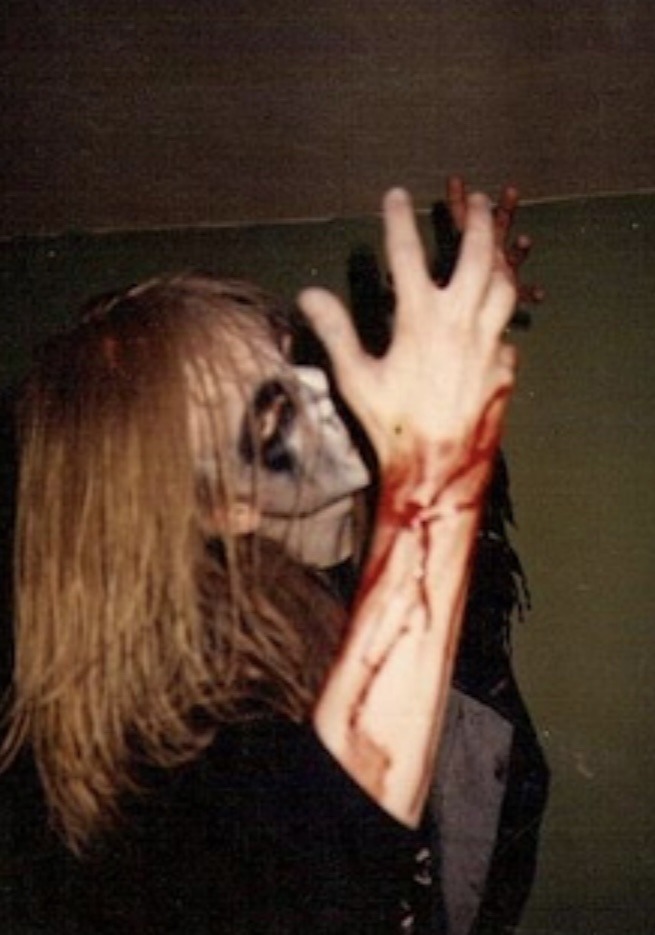
It’s not only the sound of the album which feels chthonic. The vocals and lyrics are so evocative of the unquietly buried. There’s another layer of expectations unnerved here, and another layer of Mayhem’s gruesome legend; in the lyrics of DMDS, in their fixation on alienation from life, uneasiness with the sunlit world and indeed even with embodied existence, you hear the preoccupations of Dead, the band’s almost spectral lead singer. He was dead (and not just Dead) long before the album’s completion, by his own hand, but I don’t think you have to believe in any sort of supernatural happenings to feel how much he haunts the record. Dead, ultimately, without going too far into speculation, could not get himself congruent with life, could not sync with the rhythms most people could hear. Alongside Euronymous, he formed the band’s emotive center, and his suicide, gruesomely if appropriately, did not in any way shift that center elsewhere; his living absence is a ghost-presence of its own, exerting thematic, tonal, and ultimately tragic articulation on the album. While no one could really replace Dead, plenty of people in Norway’s black metal community could have stepped in and provided vocals with a minimal learning curve, given the band’s many bootleg circulations of live material for which the singer had been present- there was working-draft familiarity among this crowd with the songs intended for DMDS.4 Mayhem did not do that. Euronymous did not recruit anyone who could have expedited the process of getting this damned album finished, but instead brought in a Hungarian vocalist, to Norway, who had no such familiarity.
And it works so incredibly well. Attila Csihar has a weird freaking voice, and it fits the underworld tone of DMDS so indelibly that it now feels obvious that he should have been chosen for it, the way a lot of unorthodox but brilliant choices do, in hindsight, feel obvious. Both Csihar and Dead have startlingly deep voices for black metal, though both edge toward that genderless, ageless quality the genre supports so well. Neither ever sound like they’re breathing, and the effect is that of listening to a corpse speak, airless and rasping. There are times on the album where it’s disturbingly difficult to tell what beat Csihar is following, times when his voice feels like it’s moving at a far slower rate than anything else in the song, and you’re left struggling to reconcile the words with the music, not sure what you should be following. Accounts of exorcisms will often discuss the Voice, the consciousness of an evil entity working its damnedest to corrode your focus, your sense of self:
“The first few syllables seem to be those of some word pronounced slowly and thickly- somewhat like a tape recording played at a subnormal speed. You are just straining to pick up the word and a layer of cold fear has already gripped you- you know its sound is alien. But your concentration is shattered and frustrated by an immediate gamut of echoes, of tiny, prickly voices echoing each syllable, screaming it, whispering it, laughing it, sneering it, groaning it, following it. They all hit your ear, while the alien voice is going on unhurriedly to the next syllable, which you then try to catch, while guessing at the first one you lost.”5
Whether or not you want to believe the words of a dodgy Jesuit is up to you, but think about this description and listen to, say, “Cursed in Eternity” and tell me there isn’t some awful, fantastic correspondence there. Black metal has thematically been preoccupied by the past since its inception, as a lot of horror frequently is; usually, this backward-glancing fixation betrays a dissatisfaction with contemporary circumstances, the hint that there was some anti-Eden at one point in time from which we’ve been excluded. This often, in black metal, takes the form of virulent anti-Christian sentiment.6 The past is ambivalent in DMDS, as are so many commonplaces of black metal. There’s no crowing about a resurgent, triumphant heathenism here, the superstitions and rituals of the past not seeming too distant from modern equivalents of whistling through the graveyard: “Woeful people with pale faces/Staring obsessed at the moon/Some memories will never go away/And they will forever be here.”7 It’s an apt description of a haunting, of the recursive arc of history crumbling back on itself and doomed to repeat, a disavowal of the idea of progress, an anti-modernism which manifests as anti-teleology. Humanity doesn’t graduate away from primitivism for Mayhem. We just find different ways of pretending our fear of the dark is a thing of the past. The lyrical focus on the past as well as the contorted, stylized effect of the album’s mixing, which eschews the polish of so many contemporary records so violently, present a vision which is not so much indifferent to modernism as it is abusive of it. This aggression toward present conventions and self-satisfaction is a source of disruption and disquiet, a provocation toward rationalism in which much horror revels. It’s tempting, too, to see in DMDS’s sneering rejection of materialist progress the nihilist shadow of nuclear dread which continued to project into the early 90s, and under which the band’s members all grew up. If science gave us the ultimate means of self-annihilating, how could we treat it with anything but ambivalence?
Mayhem, at the time of DMDS’s recording, indeed, were astonishingly young, all its members barely out of their teens8; this leads plenty of aspiring black metallers, and many critics, to believe that what they did with this album is easily replicable. Even covers of the songs here by established bands, however, while many are excellent and intriguing, don’t capture their foreboding, the underworld crawl. This album is hard, and it is dense, and despite cripplingly low budgets, a bizarre recording schedule, and an increasingly unstable and violent social scene, Mayhem absolutely knew how to put together something which sounds inimitable and malevolent and thoroughly, diabolically intentional.
The church burnings, the arrests of several other black metal musicians in Mayhem’s orbit for assault and murder, the increasing scrutiny the scene in Scandinavia was receiving in the media, and Dead’s suicide were not the only horrors which glowered over DMDS’s release in 1994. Euronymous, too, did not live to see the album complete and public; he died in August of 1993, stabbed to death by part-time bandmate and fulltime asshole Varg Vikernes. While the larger public was fully aware of this, as the case was highly sensationalized, the audience which would have approached DMDS at the time, and those of us who approach it today, did so with this foreknowledge, too. We enter into the album somewhere in that ouroboros loop, always-already knowing too much, and that heightens our response to it as much as it occludes and warps it9.
DMDS is a haunted house, trapped in its own forever-moment of violence and dread, absorbing the sentiments of everyone who has ever heard it and responded to its tainted-ground aura. I don’t think you need to know much, if anything, about Mayhem’s fraught history to appreciate the energy which creeps through the album, but black metal is not a subgenre most listeners will stumble into- it is difficult to approach it without some preconceptions. It is hardly the only musical form to be plagued by internecine killings and a reputation for misanthropy; most sub-species of metal and their fans have long carried the stigma of antisocial tendencies, and it’s fair to suggest black metal simply took that perceived truculence and cranked it up to 1110. Thomas Mann, among many other commentators, held music and its affective potential in particular suspicion, as though it was an emotive contagion naive listeners had no immunities against. “There is something suspicious about music, gentlemen. I insist that she is, by her nature, equivocal. I shall not be going too far in saying at once that she is politically suspect.”11 There is something more brutal about music, more primal; I think of the incredible machinery of vision, in spite of its imperfections, the high-tech wonder which is the human eye, the processing power our brains devote to interpreting what we see, in contrast to the lump of bone and meat and gristle which is our ear. Maybe they are just too dumb to fool, are not sophisticated enough to allow for reason to step in and rationalize our knee-jerk response to sound. When I watch a horror movie, it’s always the sound which bothers me, and I’ll turn the volume way down if I’m watching at home or cover my ears if I’m in a theater. I can explain away horrible sights. The sound of things dreadful I’m more desperate to block out, less able to guard against. In its ability to foment maenadic frenzy in its consumers, music has always been poised as an instrument of chaos and uninhibited feeling. DMDS preys on this weakness, its graveyard chill impossible to keep out. Even after thirty years, it keeps twisting back on itself, returning, unwinding, tangling into unexpected, eerie patterns, resisting all attempts to straighten it out. Like the best horror does.
- Yes. The clown on the bed, for Christ’s sake. ↩︎
- And does still. The band has survived disasters which would have killed other bands, and their Rasputin-like refusal to submit, particularly when common sense suggests they should, is part of their infamy. ↩︎
- The broader and less black metal literate public, I think it’s safe to say, were alarmed by Mayhem, and every other black metal band, without ever having once heard them. Incidents of arson in Norway at the time, most involving churches, and the nihilistic, occult-tinged positions espoused by many fans and practitioners of the music, had persuaded a good chunk of the populace that this was a scene, and a subgenre, which was inherently terrifying and destructive. ↩︎
- Dead can be heard on several of these bootlegs, the force of his performance and vocal abilities such that he still is routinely ranked as one of black metals greatest vocalists, even with his very sparse output. ↩︎
- Malachi Martin, Hostage to the Devil ↩︎
- It also leads to white nationalism and xenophobia. While its practitioners and fanbase are probably no more likely to be bigots than any others in the metal scene, black metal is often accused of being particularly attractive to racist, antisemitic, and fascistic tendencies. The can of worms which is black metal politics is another essay in and of itself. Actually, it’s a book, and a great one: Tonight It’s a World We Bury: Black Metal, Red Politics, by Bill Peel. ↩︎
- From “Pagan Fears.” ↩︎
- Mayhem’s lineup, as might have been gathered, is convoluted. The “classic” composition is considered to be Euronymous, Dead, bassist Necrobutcher, and drummer Hellhammer. DMDS, however, was recorded with Euronymous, Csihar on vocals, Hellhammer, and Varg Vikernes as session bassist, though the latter does not appear on any credits. Blackthorn, another musician, was in large part responsible for assembling Dead’s drafts into finished lyrics. ↩︎
- Not to get too wildly metaphysical- I have to put that degree to use somewhere, come on- but I feel DMDS is haunted as much by the death of possibility as it is by, you know… actual death. What would Mayhem have been had Euronymous and Dead been around to continue it? Their losses, in many ways, feel like the primordial originating point of so much later black metal, the subgenre’s What If. Feels like every musical genre has one. ↩︎
- Metal joke! ↩︎
- Thomas Mann, The Magic Mountain. ↩︎
 the shadowes are icumen in